

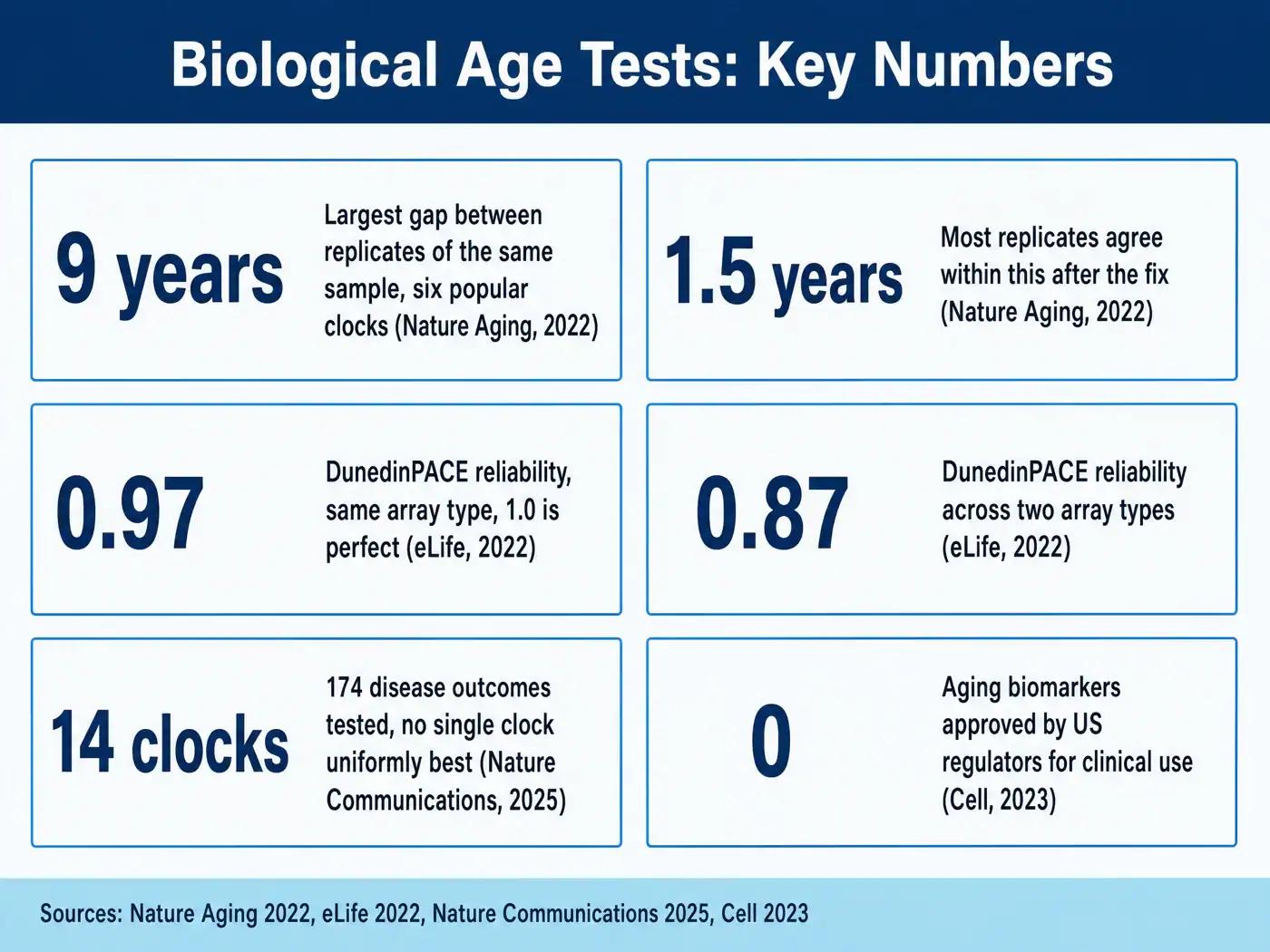
A biological age test hands you one number that sounds precise. The evidence I found says it’s shakier than the marketing suggests. Technical noise alone moved the same sample by up to 9 years on six popular epigenetic clocks, and as of 2023, no aging biomarker had US regulatory approval for clinical use.
Key Takeaways
- Replicates of the same sample differed by up to 9 years across six popular clocks (2022). A redesign brought most within 1.5 years.
- DunedinPACE reliability was 0.87 to 0.97 depending on the array type (2022).
- A 2025 analysis of 14 clocks and 174 disease outcomes found no single clock uniformly best (reported in 2026).
- As of 2023, no aging biomarker was approved by US regulators for clinical use.
- Trials report clock changes of 0.66 to 3.2 years, mostly in post hoc or exploratory analyses. Whether that means better health is unproven.
- About 40% of the experts surveyed in 2024 track their own health with these tests.
I wanted to know whether a biological age test is worth buying, so I went looking for the numbers behind the sales pages. Most of what ranks for this search is brand copy. The evidence sits in a handful of papers written for researchers.
I read three recent reviews and the two studies behind the most quoted reliability figures. This is what they say, with the year on every source.
What Does a Biological Age Test Measure?
Most consumer biological age tests read chemical tags on your DNA, called methylation, and convert them into an age. Others read sugar patterns on antibodies. A few report a speed of aging rather than an age.
The 2023 Cell consensus paper separates tools that estimate how much aging has happened from tools that estimate how fast it is happening now. The authors compare them to an odometer and a speedometer. A high reading on the first could mean you are aging fast now, or that you aged fast earlier and have since slowed.
| Test | What it reads | Commercial use noted | Source |
|---|---|---|---|
| DNAmAge (Horvath, Hannum) | DNA methylation tied to chronological age | Licensed for estimating chronological age | Cell, 2023 |
| PhenoAge and GrimAge | DNA methylation tied to clinical measures | Licensed for optimizing life insurance | Cell, 2023 |
| DunedinPACE | DNA methylation tied to pace of aging | Licensed for tracking the rate of aging | Cell, 2023 |
| GlycanAge | Sugar patterns on IgG antibodies | Used to track responses to lifestyle changes | Cell, 2023 |
Consumer kits bundle these. TruDiagnostic describes its TruAge kit as 75 epigenetic biomarkers across biological age, aging speed, and organ-specific aging for 11 body systems. GlycanAge reads antibody sugar patterns from an at-home finger-prick kit.
The sample matters. Most clocks are trained on blood or saliva, which limits how well they carry over to other tissues, according to a 2026 eBioMedicine commentary. Blood-based clocks could mostly reflect the blood and immune system rather than your heart, brain or muscle.
How Accurate Is a Biological Age Test?
It depends on the clock and the lab, and the gap can be large. The best reliability data I found run from near-perfect agreement to nine years of noise.
In 2022, Higgins-Chen and colleagues tested technical replicates, the same sample run more than once. They reported deviations of up to 9 years between replicates for six prominent clocks. Their redesigned versions brought most replicates within 1.5 years.
| Metric | Value | Source |
|---|---|---|
| Largest gap between replicates, six popular clocks | Up to 9 years | Nature Aging, 2022 |
| Replicate agreement after redesign | Most within 1.5 years | Nature Aging, 2022 |
| DunedinPACE reliability (ICC), 36 replicate datasets | 0.96 | eLife, 2022 |
| DunedinPACE reliability, same array type, 28 replicates | 0.97 | eLife, 2022 |
| DunedinPACE reliability across two array types, 350 replicates | 0.87 | eLife, 2022 |
An ICC of 1.0 would be perfect agreement. DunedinPACE’s 0.87 to 0.97 is good, and the lowest figure appears when the replicate is run on a different type of array. A clock that is steady in one setup can wobble in another.
Reliability is not the same as being right. Different clocks give different answers. A December 2025 Nature Communications analysis, summarized in the 2026 eBioMedicine commentary, compared 14 clocks across 174 disease outcomes. Effect sizes and the number of significant associations varied substantially, and no single model was uniformly superior.
The Cell paper adds that the usual accuracy yardsticks, sensitivity and specificity, fit badly here. There is no consensus on thresholds, and no way to say whether a true biological age was “correctly” found.
Confidence level: medium. The replicate and reliability figures come from two 2022 papers, so a lab’s current pipeline may do better. These papers do not give figures for any specific company’s current test.
Does a Biological Age Test Predict Anything?
Yes, in groups of people and for some outcomes. For one person, the evidence is much thinner.
The eLife paper reported DunedinPACE was associated with morbidity, disability and mortality across several cohorts, including 2,471 people in the Framingham Heart Study Offspring cohort. A November 2025 meta-analysis of 13 studies found that people with accelerated biological aging on epigenetic clocks were consistently more likely to have a stroke, with a stronger link for a first stroke.
The 2024 Nature Aging paper notes these biomarkers have been shown to outperform chronological age for estimating future hospital admissions. That is useful for research and for health systems. It does not tell you what to do on Tuesday.
Most clocks also learn from correlation, not cause. Whether the methylation changes drive decline or just accompany it is still open, according to the commentary. If you want a number with a clearer next step, my guide to VO2 max by age shows one.
Can You Change Your Biological Age Test Result?
Sometimes, by a few years, in small studies. Whether that means you are healthier is the part nobody has shown.
| Trial | Intervention and group | Clock result | Source |
|---|---|---|---|
| CALERIE | 2 years of calorie restriction, 218 adults aged 21 to 50 | DunedinPACE and PhenoAge fell significantly; other clocks showed no significant effect (post hoc) | Cell, 2023 |
| DAMA | Plant-food rich diet and exercise, 219 women aged 50 to 69 | GrimAge 0.66 years lower with the dietary intervention (post hoc) | Cell, 2023 |
| MDL | Diet, exercise, stress management and supplements, 44 men aged 50 to 72 | Horvath clock 3.2 years lower (exploratory) | Cell, 2023 |
The Cell authors are clear about the catch. A reduction in epigenetic age is only meaningful if it is associated with a positive clinical change, such as lower risk of disease, frailty or death. The 2026 commentary notes that several trials already use clocks as endpoints without clear evidence that they reliably track change from an intervention.
The 2024 Nature Aging paper makes the same point from the user side. Interventions for a raised epigenetic age are “currently not well defined beyond general lifestyle recommendations.”
What the data do show is familiar. A December 2025 multi-cohort study found smoking, higher BMI, elevated glucose and poor blood pressure profiles accelerated DunedinPACE, while physical activity and a healthier diet slowed it. That is the case for the boring stuff, from daily steps to strength training after 50, and I make it in basics beat biohacks.
Is a Biological Age Test Worth the Money?
For most people, I would say not yet. Insurance does not pay, and the experts who study these tests are split on using them themselves.
| Test | Sample | Price | Source |
|---|---|---|---|
| TruDiagnostic TruAge | At-home kit | $499 one-time, or $249.50 per test on an annual plan of 4 tests ($998 billed upfront, marked as a limited-time 50% off) | TruDiagnostic, Oct 2026 |
| GlycanAge test | Finger-prick blood kit | £322 (listed down from £379), with a 1-on-1 result interpretation call included | GlycanAge, Oct 2026 |
TruDiagnostic says its tests are not currently covered by insurance but are eligible for FSA or HSA reimbursement in most cases. The 2024 Nature Aging paper explains part of why. Below 3% of US healthcare spending goes to preventive medicine, according to the OECD figure it cites, and many countries lack ways to pay for preventive tests.
That paper surveyed 29 experts. About 40% said they track their own health with biomarkers of aging. The rest cited caution about individual predictiveness (the tests are “not there yet”), being in good health, and unclear actionable insights. Most of those who did track used ordinary clinical metrics such as blood chemistry, inflammatory markers or body composition. Wearable glucose monitors are the consumer end of that tracking, and I compared the two main ones in Stelo vs Lingo.
One caution: the respondents were mostly preclinical academic scientists, which the authors list as a limitation. The same paper notes that epigenetic clocks are often too expensive for high-throughput use, while blood chemistry panels are cheaper but less predictive.
Confidence level: low. Prices are as listed on each company’s page on October 29, 2026, and promotions change often. Check the page on the day you buy.
What Would I Do Instead of Buying One?
If I bought one for curiosity, I would treat it as one noisy reading and never as a verdict. I would not change medication, supplements or plans because of it. A number that can move by years on lab noise is not one to react to.
If I wanted a number that points at an action, I would spend the money elsewhere. A VO2 max test, a DEXA scan or an at-home blood test all come with defined next steps. My body fat percentage by age piece shows how a measured number can sit against a reference.
If your real question is about hormones after 50, weight or GLP-1 drugs and longevity, those are doctor conversations, and a clock result will not settle them. If supplements are what you are weighing, start with best vitamins after 50. Otherwise start from the health hub or losing belly fat after 50. Nothing here is medical advice.
A biological age test is a clock you cannot yet set. I would wait until someone shows what to do when it runs fast.
Frequently Asked Questions
How accurate is a biological age test?
It depends on the clock. In a 2022 Nature Aging study, technical noise moved replicates of the same sample by up to 9 years across six popular clocks. DunedinPACE reliability was 0.87 to 0.97 in eLife in 2022. No one can check accuracy against a true biological age, because none is known.
Can a biological age test tell me how long I will live?
Not for one person. Clocks are associated with disease and mortality across groups, such as DunedinPACE in the 2,471-person Framingham Offspring cohort. Whether a single result should change your care is unproven, and as of 2023 no aging biomarker had US regulatory approval for clinical use.
Does insurance cover a biological age test?
TruDiagnostic says its tests are not currently covered by insurance but are eligible for FSA or HSA reimbursement in most cases. A 2024 Nature Aging paper adds that many countries lack ways to pay for preventive testing, and that below 3% of US healthcare spending goes to prevention.
Which biological age test is most accurate?
No source I read ranks them. A 2025 analysis of 14 clocks across 174 disease outcomes found none uniformly superior, according to a 2026 eBioMedicine commentary. Check which clock a company uses and whether it publishes reliability data for that clock.
Can I lower my biological age?
Small trials report clock changes of 0.66 to 3.2 years after diet, exercise or similar programs, mostly in post hoc or exploratory analyses. Whether that means better health is unproven. A December 2025 study found smoking and high glucose speed DunedinPACE, while activity and healthier diet slow it.
Is a biological age test worth it after 50?
I would not buy one expecting an answer. Experts surveyed in Nature Aging in 2024 cited few clear actions to take from a result. Tests with defined next steps, like blood work, VO2 max or a DEXA scan, give you more to act on.
Methodology and sourcing. I read the full text of the 2026 eBioMedicine commentary, the 2024 Nature Aging survey paper and the 2023 Cell consensus paper on October 29, 2026, along with the 2022 eLife DunedinPACE paper and the abstract of the 2022 Nature Aging replicate study. Company details come from each company’s own website as of the same date.
By year, the sources are one from 2026, one from 2024, one from 2023, and two from 2022.
Limits: the 14-clock Nature Communications analysis and the 13-study stroke meta-analysis are cited through the 2026 commentary. The Cell trial table is a 2023 snapshot.
The DunedinPACE hazard ratios are left out because one figure in that paper is internally inconsistent. I kept third-party review sites out as sources. Nothing here is medical advice.
