

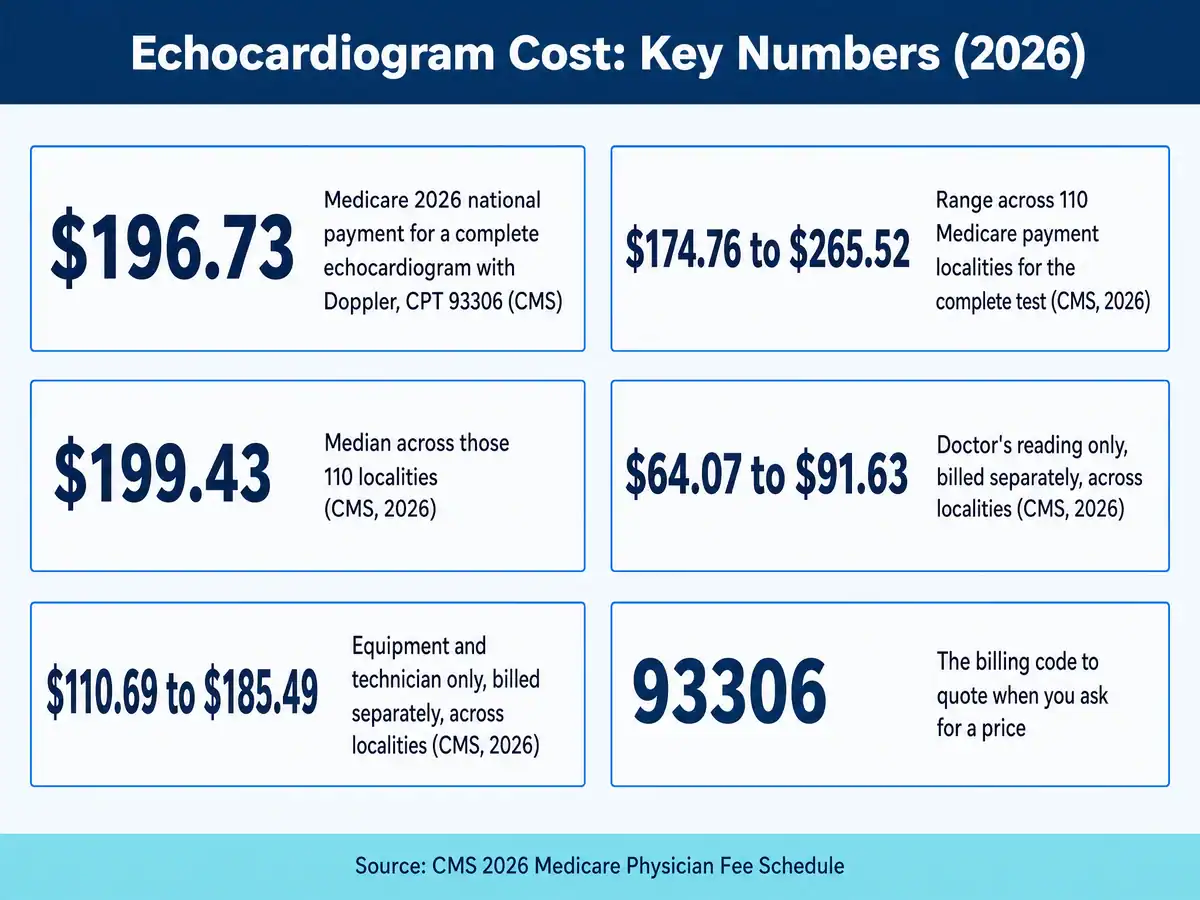
Echocardiogram cost has a clean public benchmark: Medicare pays $196.73 nationally in 2026 for a complete echo with Doppler. It ranges from $174.76 to $265.52 depending on where you live. That is what Medicare pays the provider, not a price list for patients.
Key Takeaways
- The national Medicare payment for CPT 93306 is $196.73 in 2026.
- Across 110 localities the full payment runs $174.76 to $265.52, with a median of $199.43.
- The payment splits into equipment and technician ($110.69 to $185.49) and the doctor’s reading ($64.07 to $91.63).
- This is a Medicare-allowed fee, not a hospital bill, not a cash price, and not your coinsurance.
- I found no provider self-pay price pages for an echo, so I can’t quote a cash price.
- When you ask for a price, quote CPT 93306 so you compare the same test.
Ask three clinics what an echocardiogram costs, and you will get three answers, none in writing. That is the real problem with echocardiogram cost: the test is standard, the code is standard, and the price is anything but visible.
So I started from the one source that does publish prices. The CMS physician fee schedule lists what Medicare pays for every billing code.
What Is the Average Echocardiogram Cost?
For a complete transthoracic echo with Doppler, CPT 93306, the national Medicare payment in 2026 is $196.73. That comes from 5.89 relative value units multiplied by the conversion factor of $33.4009, my arithmetic on the CMS figures.
Across the 110 payment localities in the CMS price file, the full payment runs from $174.76 to $265.52, with a median of $199.43. The same figure applies whether the test is done in a facility or an office, because the file shows no difference.
Confidence level: high. These figures come straight from the CMS files. The only calculation is the national figure, which multiplies the published relative value units by the published conversion factor.
What this number is not matters more than what it is. It is the allowed payment for the clinician services under Medicare. It is not the sticker price a hospital might bill, and it is not what an uninsured patient is quoted.
What Does the Echocardiogram Cost Pay For?
A transthoracic echocardiogram is an ultrasound of the heart taken through the chest wall. A sonographer moves a probe across your chest while the machine records the heart’s size, its chambers, and how the valves move.
The Doppler part measures blood flow through the heart. CPT 93306 bundles the two-dimensional images with Doppler into one complete study, which is why that code is the standard thing to quote.
Other echo variants have their own codes and their own prices. This article covers 93306 only, so a stress echo or an echo through the throat would need a separate lookup.
Echocardiogram Cost by Component
One echo bills as two pieces. The technical component covers the machine, the room, and the sonographer. The professional component, modifier 26, covers the doctor who reads the images. Billed together, you get the global figure.
| Part of the echo | National RVU | Local payment range | Median |
|---|---|---|---|
| Global (both parts) | 5.89 | $174.76 to $265.52 | $199.43 |
| Technical component (machine, technician) | 3.87 | $110.69 to $185.49 | $131.36 |
| Doctor’s reading (modifier 26) | 2.02 | $64.07 to $91.63 | $68.13 |
At the national rate that works out to about $129 for the technical part and $67 for the reading, adding to the $196.73. About two-thirds of the echocardiogram cost is equipment and staff, not the doctor.
The medians do not add up exactly to the global median, because each is the middle of a separate list of 110 localities.
Why Does Echocardiogram Cost Vary by Location?
The Medicare formula adjusts each of the three cost pieces (doctor’s work, practice expense and malpractice) by a local index, then multiplies by the conversion factor. Same code, same relative value units, different local indexes.
That explains the $90.76 gap between the lowest and highest locality (my arithmetic). It reflects local costs built into the formula. It doesn’t mean the test is better or worse anywhere.
Bear in mind that Medicare is one payer. Private insurers negotiate their own rates, and each provider sets cash prices. Neither shows up in these files.
What I Could Not Find on Echocardiogram Cost
I looked for provider pages that publish a self-pay price for an echo and found none I could use as a primary source. The price comparison sites that list numbers are aggregators, and I haven’t cited them.
The CMS files also carry hospital outpatient columns, but those show only practice-expense amounts. They don’t show hospital payment, so I haven’t quoted one. The same goes for coinsurance, which depends on your plan.
Confidence level: low. Treat anything about what you would personally owe as unconfirmed until your plan or the provider tells you.
How Do You Find Your Own Echocardiogram Cost?
Call the provider and ask for a written quote for CPT 93306, global, and say whether you are paying cash or using insurance. Ask whether the doctor’s reading is billed separately. If it is, get both figures.
Then compare against the Medicare number above. A cash price far above $197 is not automatically wrong, since commercial and self-pay rates differ, but it is a reason to ask what the extra pays for.
If you are shopping for other tests, the same approach applies. See my guides to DEXA scan cost, VO2 max test cost and colonoscopy cost. Coverage questions before 65 are in health insurance before Medicare.
What Would I Do With This Information?
I would treat $197 as the anchor and ask every provider to beat it or explain it. I would not pay for an echo because a wellness package bundled it in. If a doctor orders one, I would ask what decision the result will change.
I would also keep the bigger picture in view. Heart health after 50 is mostly built from boring things: steps, lifting, sleep, and blood pressure. My piece on why the basics beat the biohacks covers it.
For fitness measures that sit alongside heart tests, see VO2 max by age and at-home blood test kits. For the wider picture, the health hub. Nothing here is medical advice.
Where Does Echocardiogram Cost Fit Among Other Health Tests?
An echo is cheap compared with a hospital stay and expensive compared with a blood test. At roughly $200 for Medicare, it sits in the same bracket as the scans and fitness tests I’ve priced elsewhere on this site.
The useful comparison is not price alone. It is what you will do differently after the result. Someone with symptoms and a doctor’s order is in a different position from someone buying a screening on impulse.
If hormones or weight medication are on your list of things to discuss with a doctor, my overviews of hormones after 50 and GLP-1 drugs and longevity may help you prepare questions.
Frequently Asked Questions
How much does an echocardiogram cost?
For Medicare, the national payment for a complete echo with Doppler (CPT 93306) is $196.73 in 2026. Across 110 localities it runs $174.76 to $265.52. That is Medicare’s allowed fee for the doctor’s services, not a hospital bill or self-pay quote.
What is CPT 93306?
It is the billing code for a complete transthoracic echocardiogram with Doppler, the standard heart ultrasound done through the chest wall. Quote that code when you ask any provider for a price so you compare the same test.
Why do I get two bills for one echo?
Medicare splits the payment into the equipment and technician part and the doctor’s reading. Nationally, those are about $129 and $67, together about $197. Billing the parts separately can look like two charges.
Does the echocardiogram cost differ by location?
Yes. The same global code is paid from $174.76 to $265.52 across the 110 Medicare localities. The gap comes from local cost adjustments in the formula, not from the test being different.
What will I pay without insurance?
I could not find a provider self-pay price page for an echo, so I cannot give a cash price. Medicare’s figure is a reference point only. Ask the provider for a written self-pay quote for CPT 93306 before you book.
Does Medicare cover an echocardiogram?
Check with Medicare, your plan, or your doctor’s billing office for what you would owe.
Methodology and sourcing. I worked from the CMS physician fee schedule price lookup for CPT 93306 (110 localities, conversion factor 33.4009) and the CMS relative value files (release dated 12/29/2025).
Limits: this is a Medicare-allowed payment for clinician services. It is not a hospital charge, a private insurance rate, or a cash price. I found no usable provider self-pay pages and excluded third-party price aggregators.
The $196.73 national figure, the $129 and $67 split, and the $90.76 spread are my arithmetic on CMS figures. Nothing here is medical advice.
