

Short version: the best home gym for beginners over fifty is smaller than you think: adjustable dumbbells, a floor mat and resistance bands. My dumbbell pick is the PowerBlock Sport 24 ($219), and the whole starter kit is about $358. Want to start cheaper? A single kettlebell is $45.99. Prices checked on manufacturers’ pages, October 14, 2026.
Most home gyms end up as expensive laundry racks. You’ve seen one. You may have hung a shirt on one this morning. Here’s mine!
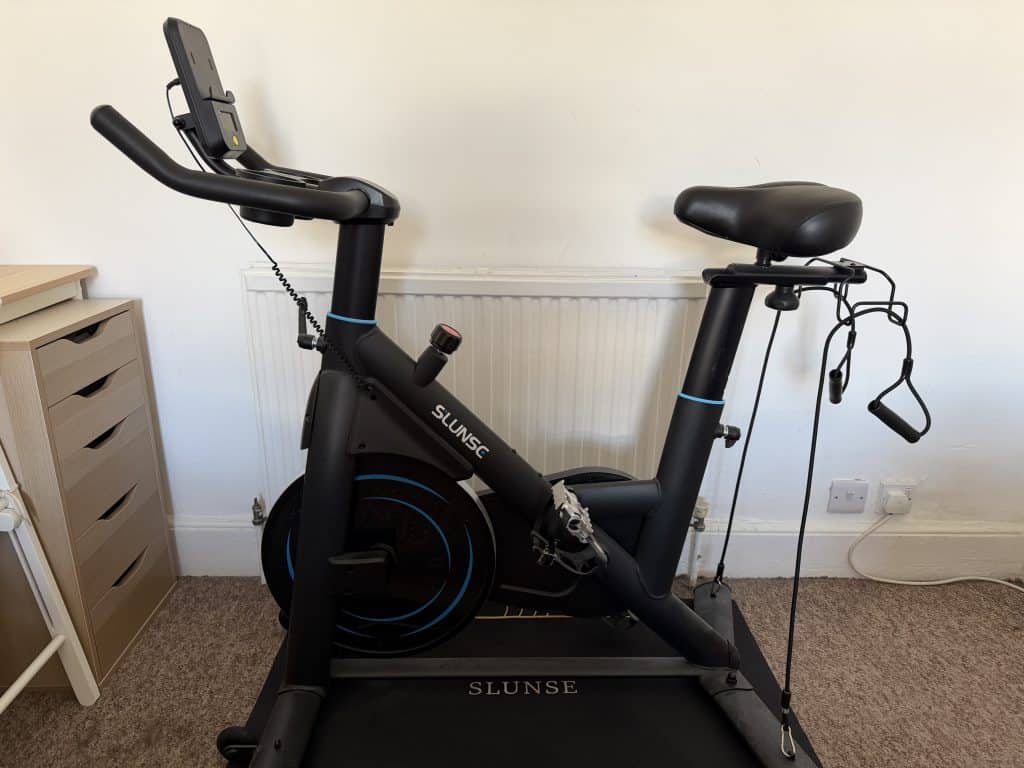
The fix isn’t a better machine. It’s buying less, in the right order, and starting with the things you’ll still be using at Christmas.
That’s what this page is: nine pieces of equipment, ranked by what a beginner should buy first, with specs and prices taken from the manufacturers rather than from other roundups. It sits alongside everything else I write on my Health After 50 hub, where the rule is the same: check what’s true before telling you what to buy.
Affiliate disclosure: Nothing on this page is an affiliate link.
Home gym for beginners: my nine picks
How they compare
| Product | Best for | Price | Key spec | Warranty |
|---|---|---|---|---|
| Rep Fitness Kettlebell | First buy | $45.99 (8 kg) | 4–48 kg range, sold individually | Not published |
| PowerBlock Sport 24 | Overall starter | $219 | 3–24 lb per hand, 3 lb steps | 5 years |
| Bodylastics 6-Band Set | Portable | $61.97 | Six bands rated 3–90 lb | Not published |
| Rep 4×6 Floor Mat | Floor protection | $76.99 | ¾ in thick, 88 lb | Not published |
| BowFlex SelectTech 552 | Upgrade | $328.99 | 5–52.5 lb per hand, 15 settings | 2 years (parts) |
| Rep AB-3100 Bench | Incline and seated work | $269.99 | 700 lb capacity, 6 back positions | Not published |
| Sunny SF-RW5515 Rower | Low-impact cardio | $239.99 | 250 lb user limit, 8 levels | 3 years (frame) |
| Sunny SF-T722021 Treadmill | Walking cardio | $549.99 | 0.6–9 mph, 265 lb user limit | 3 years (frame) |
| TRX Home2 Bundle | Bodyweight training | $253.08 | Door and suspension anchors | 2 years |
“Not published” means the product page doesn’t state it. It links to a separate warranty page for Rep, and Bodylastics doesn’t spell the terms out on the page I read. Prices are the manufacturers’ current figures as of October 14, 2026. BowFlex ($479 regular) and TRX ($337.44 regular) were both on sale.
Why I’d start with strength, not cardio
Muscle loss starts earlier than most of us notice. The Office on Women’s Health says the body begins losing 3–5% of its muscle mass per decade from around age 30, and that the loss tends to become obvious by about 60.
Strength training is the standard answer. The CDC’s guidance for adults 65 and older asks for at least 150 minutes of moderate aerobic activity, at least two days of muscle-strengthening work, and activities that improve balance. A fair target to grow into at fifty-plus. For women starting out, there’s a dedicated guide to strength training for women over 50. The overview of the evidence is in strength training after 50.
There’s a bigger claim, too. A pooled analysis of 16 studies in the British Journal of Sports Medicine (Momma et al., 2022) linked muscle-strengthening activity to a 10–17% lower risk of death from any cause (relative risk 0.85, 95% CI 0.79 to 0.93). The link was J-shaped: strongest at roughly 30–60 minutes a week, weaker beyond that.
Confidence level: Medium. The muscle-loss figure and the activity guideline are well established. The mortality result comes from observational studies, so it shows an association, not proof that lifting weights is the cause. People who lift also tend to look after themselves in other ways.
Thirty to sixty minutes a week. That’s two short sessions with a pair of dumbbells, which is why dumbbells lead this list.
If you have heart disease, uncontrolled blood pressure, a recent surgery or joint replacement, or you haven’t exercised in years, run the plan past your doctor first. No piece of equipment will do that for you. Balance work matters here too, and I’ve put a set of balance exercises in a separate piece.
Women going through menopause have a specific reason to care. I covered the evidence in my piece on menopause belly fat. For men, hormones shift muscle and energy over the same decades, and testosterone levels by age lays out the numbers. The wider hormone picture is in hormones after 50. If you’re a man, I covered how often to lift and how heavy in strength training for men over 50.
What to buy first, and what to skip
First buy, $45.99 to $59.99. A single Rep kettlebell, 8 kg or 12 kg. It’s the cheapest way to find out whether you’ll actually train at home, and it was my first piece of kit.
Tier one, about $358. The PowerBlock Sport 24 ($219), the Rep floor mat ($76.99) and the Bodylastics bands ($61.97). That covers pressing, rowing, squatting, carrying and a bit of everything with bands. It fits in a closet.
Tier two, about $628. Add the Rep AB-3100 bench ($269.99). Now you can do incline presses and seated shoulder presses with something behind your back. Only add it once you’ve used tier one for a month.
Tier three, about $868 with the rower or about $1,178 with the treadmill. Add the Sunny rower ($239.99) if your joints like low-impact cardio and you have 82 inches of floor to spare.
Add the Sunny treadmill ($549.99) if walking is your cardio. Walking outside is free, though, and how many steps a day and the benefits of walking two miles a day make a stronger case for it than most machines do.
If rowing isn’t for you, my roundups of the best exercise bikes and the best recumbent bikes cover the seated alternatives.
What I’d skip as a beginner: racks, cable machines and the $3,545 smart gym one competitor roundup lists. Those are different tiers, and most people who buy them first don’t finish the first month. I didn’t price them.
What’s my decision, in one line?
The nine picks in detail
Every price and spec below comes from the manufacturer’s own product page, checked on October 14, 2026. Where a manufacturer doesn’t publish something, I say so in the entry instead of guessing. Owner evidence comes from me, YouTube comment threads, and Reddit; where I couldn’t find reports on the exact product, I say that too.
Rep Fitness Kettlebell — Best First Buy
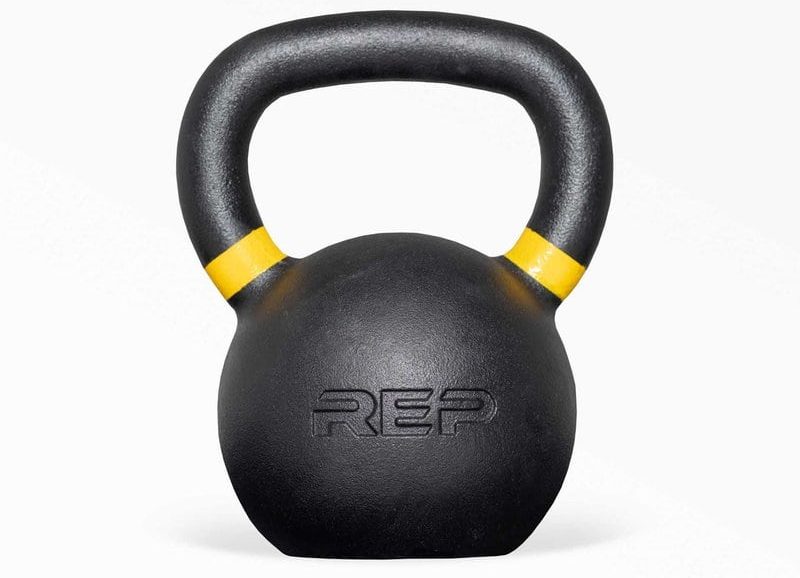
$45.99 (8 kg, 17.6 lb) · $59.99 (12 kg, 26.5 lb) · 4–48 kg range · Sold individually
This is the first piece of gym equipment I ever bought, and it’s still the cheapest honest way to start. One iron ball with a handle trains hinging, squatting, and carrying, which covers a lot of what everyday life asks of a body after fifty.
Rep sells sizes from 4 to 48 kilograms. As a rule of thumb of mine, not Rep’s: 8 kg if you’ve never lifted, 12 kg if you have. Rep says each bell is iron-cast, with color-coded handles and weight marked in both kilograms and pounds. Today the 14 to 20 kg sizes show as pre-order.
Pros
- The cheapest way in on this list
- One tool for hinge, squat and carry movements
- Free shipping and a 30-day money-back guarantee, per Rep’s page
Cons
- One fixed weight, so you’ll want the next size up within months
- Sizes are in kilograms, so you’ll be converting
- The 14 to 20 kg sizes were on pre-order on October 14
- Swings need technique; learn the hip hinge before you swing
Who it’s for: anyone who wants the cheapest possible start. Who should skip it: anyone with current back pain until a doctor or physical therapist says otherwise.
Rep’s page shows 497 reviews averaging 4.9 stars, with 465 five-star and two one-star. The praise centers on handle size and finish. Rep’s own summary of its 100 most recent reviews also notes occasional chipping on the base after heavy use. One reviewer returned a competitor’s bells because the handle was short enough to land on their wrist.
These are Rep’s own on-site reviews, so treat them as a friendly sample, not independent evidence. Rep’s page doesn’t state a warranty for this product. I have used mine for 25 years, and I still love it.
PowerBlock Sport 24 — Best Overall
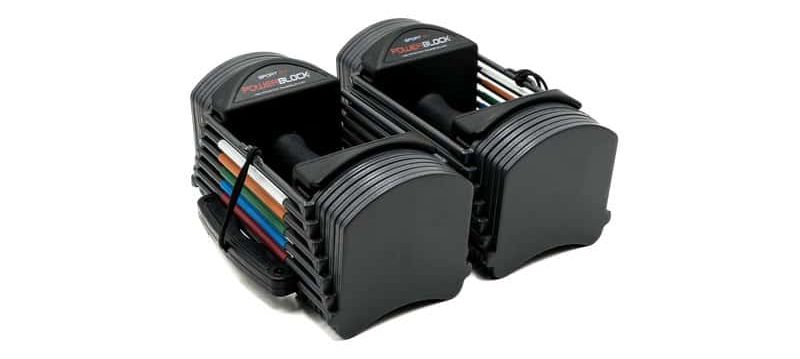
$219 · 3–24 lb per hand in 3 lb steps · Sold as a pair · 5-year limited warranty
This is the second piece of gym equipment I ever bought, and I still use it every week watching TV in the evening. And my wife loves them because they’re easy to hide under our couch.
The pitch is really simple: one pair that sits on a shelf and replaces eight pairs of fixed dumbbells. You move a pin to pick the weight. Each dumbbell measures about 10 by 5.5 by 5.5 inches.
I put it first because a beginner needs low friction more than a high ceiling. The 24-pound limit is real, and PowerBlock says plainly that the Sport 24 can’t be expanded. It still covers curls, rows, shoulder presses, and most of what you’ll do in your first months.
Pros
- Compact pair that stores almost anywhere
- 5-year warranty, the longest on this list for dumbbells
- 3 lb jumps make progress easy to measure
- The cheapest adjustable pair in my ladder
Cons
- Hard 24 lb cap per hand; the Sport 24 can’t be expanded
- One owner says the squared-off block shape rules out goblet squats
- Residential use only; the warranty excludes commercial use
Who it’s for: beginners with limited space, and anyone coming back after a long gap. Who should skip it: anyone who already presses heavy; you’ll outgrow 24 pounds quickly.
The owner threads I found are mostly about PowerBlock’s bigger Elite models, not the Sport 24, so treat this as the same design rather than the same product.
Within that: owners call PowerBlocks the most durable of the adjustable sets they’ve tried, and one described them as bombproof and cheaper than the rivals. The complaint that keeps coming back is feel. A couple of owners disliked their hand sitting in a cradle.
I found no owner reports on the Sport 24 itself.
Bodylastics 6-Band Set — Best Budget
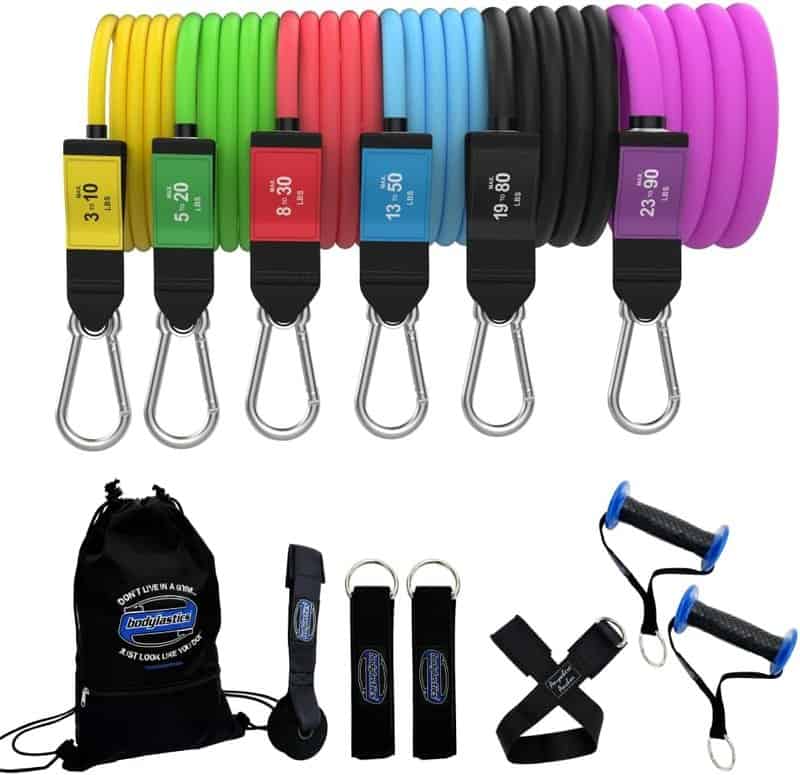
$61.97 · Six bands, 3–90 lb ratings · Door anchor, handles, ankle straps and bag included
Bands are the cheapest way to start, and the only item here you can pack for a trip. The set has six bands rated 3–10, 5–20, 8–30, 13–50, 19–80 and 23–90 pounds, plus a door anchor, a small anywhere anchor, two handles, two ankle straps and a bag.
The title says “280 lbs max tension.” The page doesn’t explain it. The six top ratings add up to exactly 280 (10 + 20 + 30 + 50 + 80 + 90), so that’s likely what it means. That is my arithmetic, not Bodylastics’ statement, and you’d need all six stacked together to reach it.
Pros
- $61.97 for a complete set, including anchors and handles
- Light, packable and quiet
- Wide range of resistance for rows, presses and leg work
Cons
- Bands wear out; some owners report breaks after two to three years
- The product page doesn’t map colors to tension or state a warranty
- Resistance is harder to track than a dumbbell’s weight
Who it’s for: anyone starting on a tight budget, and travelers. Who should skip it: anyone who wants to log exact pounds lifted.
Owner comments under a Bodylastics review video lean positive on longevity, with several people reporting ten years or more with a set.
The same thread has the other side: bands breaking in the middle after about two years, one owner finding the thinnest bands flaking, and another saying individual bands had become unavailable. One commenter mentions a lifetime warranty. I couldn’t confirm it on the product page.
These are YouTube comments about the brand’s sets in general, not verified purchases of this exact set.
Rep Fitness 4×6 Floor Mat — Best Floor Protection
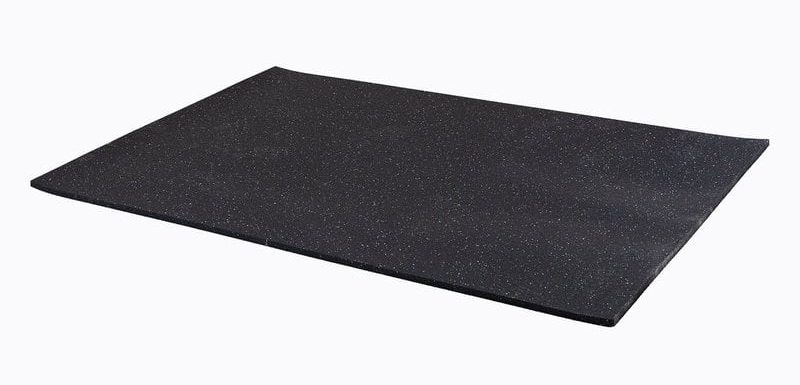
$76.99 · 47 × 71 in · ¾ in thick · 88 lb · Recycled rubber bonded with urethane
Not exciting, and the thing most beginners skip and regret. A dropped dumbbell on hardwood leaves a dent, and a bench or rower leaves marks on softer floors. A mat gives you a defined place to train, and a defined place is half the battle.
Rep’s page describes it as premium rubber made from recycled rubber bonded with liquid urethane. At 88 pounds, it’s the first thing to know before you try to move it.
Pros
- Three-quarter-inch thick rubber
- Gives you a defined workout space and some protection from dropped weights
- Recycled rubber construction
Cons
- 88 lb, so it’s a two-person move and not something you roll up and stash
- Covers 47 × 71 inches only; the Sunny rower is 81.8 inches long
- Warranty isn’t on the product page, and I found no load rating
Who it’s for: anyone training on hardwood, tile or an upstairs floor. Who should skip it: anyone with a basement slab and no neighbors below.
Too few independent owner reports to draw on yet.
BowFlex SelectTech 552 — Best Upgrade
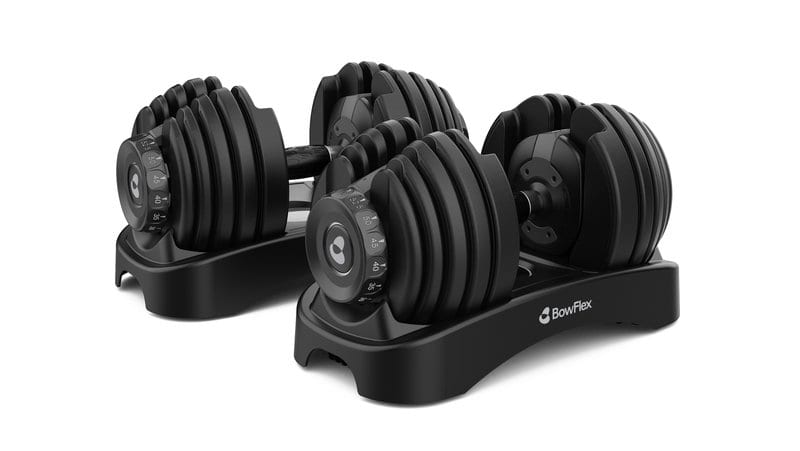
$328.99 (sale; regular $479) · 5–52.5 lb per hand · 15 settings · 2-year parts warranty · Sold as a pair
Same idea as the PowerBlock, bigger range. You turn a dial on each end and the weight steps through fifteen settings: 2.5 lb jumps up to 25 lb, 5 lb jumps after that, then 2.5 again at 50 and 52.5. Each dumbbell is 16.9 inches long.
It costs $109.99 more than the Sport 24 at today’s sale price, and that buys headroom. If you’ve lifted before, you’ll want it sooner than you think. If you haven’t, you’ll spend months below 25 pounds and the extra money does nothing yet.
Pros
- 5 to 52.5 lb per hand covers beginner through intermediate
- Dial selection changes the weight without loose plates
- Many owners report years of regular use
Cons
- The $328.99 price is a sale price; regular is $479
- 16.9 inches per dumbbell is bulky; some owners disliked the size
- Plastic parts are where owners report failures: handles, cams, plates
- BowFlex says individual settings may differ slightly from stated weights
Who it’s for: people who’ve lifted before, and anyone who expects to progress quickly. Who should skip it: true beginners on a budget; the Sport 24 is $110 less.
About a dozen long-term owner comments under a BowFlex SelectTech review, mostly on earlier versions of the same design, report five to sixteen years of regular use.
The failures cluster in the same places: a handle that broke after about ten years (replacement pair quoted at $150), a plate that came loose, a cam that broke when a dumbbell was dropped down stairs, and dials that stop turning smoothly.
On Reddit, one owner sold theirs for another type and said they were “great for what they were.”
The product page shows both a free-shipping banner and a $30 FedEx line. Check the total at checkout.
Rep AB-3100 Adjustable Bench — Best Bench
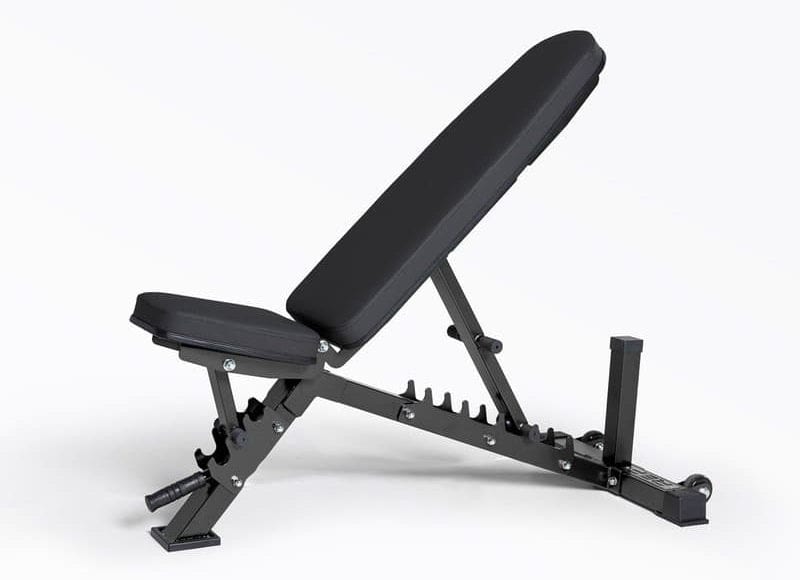
$269.99 · 700 lb capacity · Back pad 0/30/45/60/75/90° · Seat pad 0/10/20° · 70 lb
A bench turns dumbbells from “fine” into “a real gym.” You get incline presses, seated shoulder presses with something behind your back, and a stable seat for rows.
The AB-3100’s back pad locks at six angles (0, 30, 45, 60, 75 and 90 degrees) and the seat pad at three (0, 10 and 20). It measures 50.5 inches long, 23 wide and 16.75 high, with a footprint of 7.9 square feet.
Pros
- 700 lb capacity is a proxy for a stable frame
- Six back-pad angles and three seat angles
- A tapered seat pad with a non-slip textured vinyl cover
Cons
- $269.99 is a lot for a bench; one competitor roundup lists a FlyBird bench at about $120, which I haven’t checked
- 70 lb, so it isn’t something you move casually
- 7.9 sq ft of permanent floor space
- Warranty isn’t stated on the product page
Who it’s for: anyone with dumbbells and the floor space to leave a bench up. Who should skip it: small apartments (I had one, and my wife soon banished it), and anyone who hasn’t used dumbbells for a month yet.
Too few independent owner reports on the AB-3100 itself to draw on. It does turn up in r/GarageGym bench-comparison threads against other benches, which tells you it’s part of the conversation, not that it’s good.
Sunny SF-RW5515 Magnetic Rower — Best Cardio
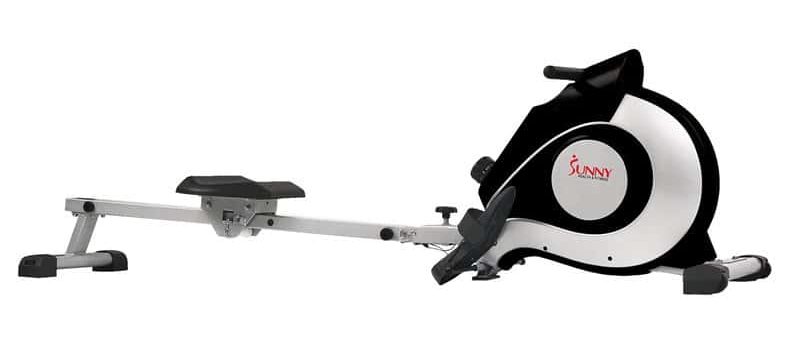
$239.99 (silver) · 8 magnetic levels · 250 lb user limit · 3-year frame warranty, 180 days on parts
Rowing is low-impact, full-body cardio with no pounding. It works legs, back and arms together, and it’s one of the few machines that still gives a stiff-kneed fifty-something a proper sweat.
Assembled, it’s 81.8 inches long and weighs 60.9 pounds. Folded upright it stands 43.3 inches long and 52.4 tall. The seat sits 10.1 to 11.7 inches off the floor, the rail is 53.4 inches, and the monitor shows time, stroke count and calories.
Pros
- Eight magnetic resistance levels
- Folds upright to roughly 43 inches long
- 3-year frame warranty
Cons
- The low seat means a real squat to get on and off
- Parts are covered for only 180 days
- The monitor shows time, count and calories, with no distance or pace listed
- The page gives the rail inseam as both 48.4 and 46.5 inches
Who it’s for: anyone with joints that object to impact and about 82 inches of floor. Who should skip it: anyone for whom a seat 10 inches off the floor is a problem; try a recumbent bike instead.
Too few independent owner reports on this exact rower to draw on. The comments I found were under reviews of other rowers, so I’m not using them.
The black version is listed at $399.99 on the same page; I’m pricing the silver at $239.99.
If you can afford the Concept2 Rower at just under a grand, and have the space, I really recommend it. I’ve had mine for 25 years, and it’s brilliant for aerobic and strength training at the same time.
Sunny SF-T722021 Slim Foldable Treadmill — Best Treadmill
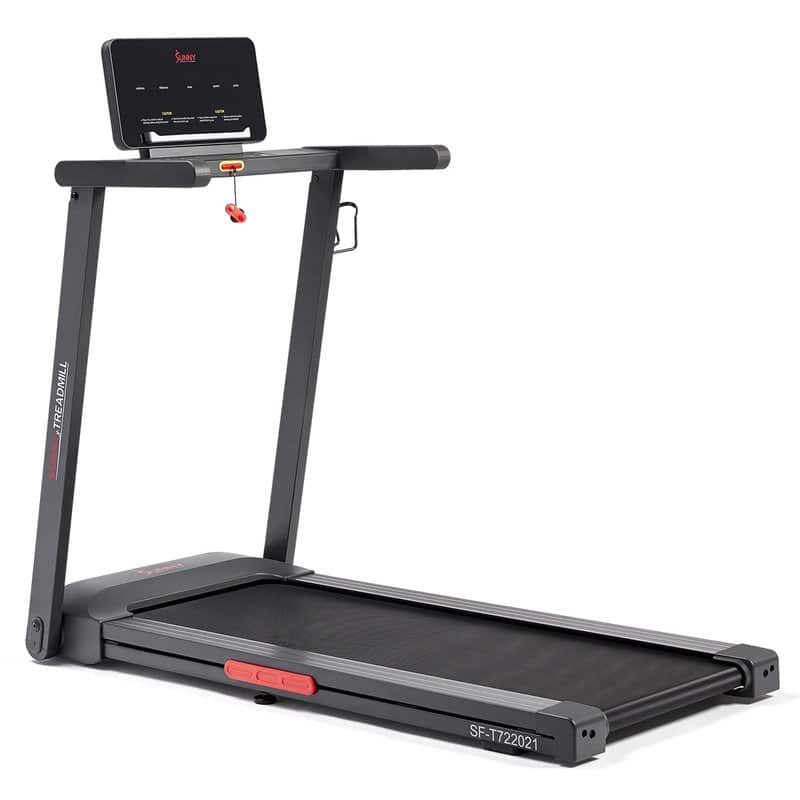
$549.99 · 0.6–9.0 mph · 47 × 17.3 in belt · 265 lb user limit · 3-year frame warranty, 180 days on parts
If walking is your cardio, a treadmill is the one machine here that slots straight into what you already do. It also ends the weather excuse. This is Sunny’s slim foldable, with a brushless 2.0 peak-horsepower motor and a speed range from 0.6 to 9.0 mph.
Assembled it’s 56.3 inches long and 30.7 wide, and it weighs 87.5 pounds. Sunny lists the folded size as 56.3 × 30.7 × 53.9 inches, the same footprint, so folding saves less floor space than you might hope.
Pros
- Real walking-to-jogging speed range, 0.6 to 9.0 mph
- 265 lb user limit
- Console shows speed, distance, calories, pulse and time
Cons
- At $549.99, the most expensive pick on this list
- The page lists only a foldable handlebar, not side handrails; check this if balance is a worry
- Incline is fixed at 0.8 degrees
- Parts are covered for only 180 days, with no separate motor warranty listed
Who it’s for: walkers who want a treadmill under $600. Who should skip it: runners, and anyone who needs full grab rails to feel steady.
Too few independent owner reviews on this exact model to draw on yet.
TRX Home2 Starter Bundle — Best for Bodyweight Training
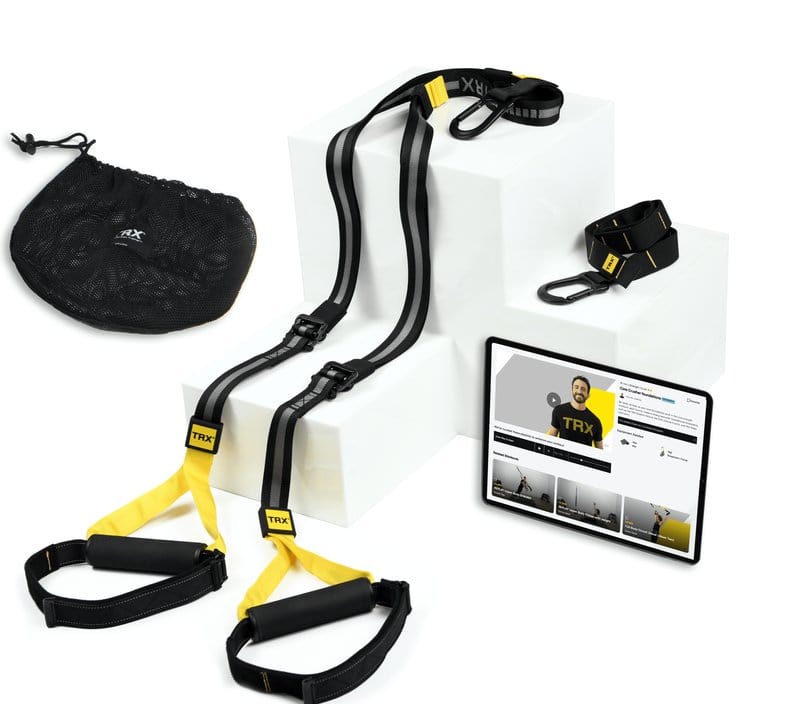
$253.08 (sale; regular $337.44) · Includes 12 months of the TRX App On Demand · 2-year warranty
A suspension trainer is a pair of straps you hang from a door, beam or hook. You lean back at an angle and use your own bodyweight. The more horizontal you go, the harder it gets. The bundle comes with the Home2 trainer and 12 months of the TRX app (2,000+ on-demand workouts).
TRX’s comparison table lists a door anchor and a suspension anchor for the Home2. That means you can set it up without drilling, though you do need a door or beam that holds.
Pros
- Guided workouts included for the first year
- Packs into a bag and needs little floor space
- Pushes, rows and core work from one device
Cons
- The app renews at $99.99 a year after the first 12 months
- No maximum user weight on the page I read
- Resistance changes only with body angle; there’s no way to add load
- The $253.08 price is a sale price; regular is $337.44
Who it’s for: people who like following along with a workout. Who should skip it: anyone who wants to track weight lifted, or who would rather not pay a yearly app fee.
Too few independent owner reviews to draw on yet.
The product page itself shows both “25% off” and “Save 20%.” I’m using the $253.08 sale price it displays.
Start small
The research above is about consistency, not kit. Two short strength sessions a week, a walk on most other days, and one balance exercise you can do while the kettle boils.
If you’re also trying to understand why the basics keep beating the gadgets, basics beat biohacks makes the same argument from a different angle. If you’re on a GLP-1 medication, keeping muscle is something to raise with your doctor; the broader picture is in my GLP-1 and longevity piece.
Tracking recovery helps too. My sleep tracker roundup and Oura ring review cover what to measure and what’s noise.
Buy the kettlebell or the dumbbells. Use them for a month. Then, and only then, buy something else. Worst case, you own a very well-engineered laundry rack with a 24-pound option.
Frequently asked questions
How much does a home gym for beginners cost?
A single kettlebell is $45.99 to $59.99. A sensible starter kit of adjustable dumbbells, a floor mat and resistance bands comes to about $358 at today’s prices. Add a bench and it’s about $628, and add a rower or a treadmill and it’s about $868 or $1,178. You don’t need to buy it all at once.
How much weight do I need to start?
That depends on you. As a rough guide, 24 pounds per hand covers most upper-body beginner moves for months, but leg exercises will outgrow it first. That’s my judgment, not a lab figure. If you’ve lifted before, the BowFlex’s 52.5 pounds gives you more room.
PowerBlock Sport 24 or BowFlex SelectTech 552?
The PowerBlock is $110 cheaper, more compact and has a 5-year warranty, but it stops at 24 pounds per hand and can’t be expanded. The BowFlex goes to 52.5 pounds, comes with a 2-year parts warranty and is bulkier, at 16.9 inches per dumbbell. Beginners are fine with the PowerBlock (I still use mine); if you’ve lifted before, buy the BowFlex.
Do I need a bench?
Not at first. You can do presses and rows from the floor or a sturdy chair. A bench adds incline presses and a supported back for overhead work, but it costs $269.99 and takes 7.9 square feet. Add it after a month if you’re still training. Your back will thank you.
Is it safe to start strength training after 50?
For most people, yes, and the CDC recommends at least two days a week of muscle-strengthening activity for adults 65 and older. If you have heart disease, high blood pressure that isn’t controlled, a recent surgery, a joint replacement or you haven’t exercised in years, talk to your doctor first.
Methodology. I read six published home gym buying guides (Cleveland Heart, Rep Fitness, Garage Gym Reviews, The Consumers Guide, Home Gym Verdict and Examiner News) and tallied every product named. Twenty distinct priced candidates came out of them, ranging from about $14 to $3,545.
The six pages ran as a mix of unpriced Amazon links and approximate prices, so the market median I used ($342.50) is approximate. I then priced and specced my nine picks directly from each manufacturer’s own page on October 14, 2026.
I left out the Concept2 RowErg, which appeared on three of the six pages (priced at about $990 and $1,299.99 depending on the page); it’s a different price tier.
Owner evidence comes from YouTube comment threads, Reddit (r/GarageGym and r/GYM) and, for the kettlebell, Rep’s own on-site reviews, read and paraphrased rather than quoted. Weak or missing evidence is flagged in each entry.
Health figures come from the Office on Women’s Health (last updated May 13, 2026), the CDC (last reviewed December 4, 2025) and Momma et al., British Journal of Sports Medicine, 2022.
Affiliate relationships: none live as of publication. Every product link goes to the manufacturer’s plain product page, not an affiliate link.
