

Recumbent bike benefits come down to low-impact aerobic exercise from a supported, seated position, which counts toward the 150 minutes of weekly activity the CDC recommends for adults 65 and older.
Key Takeaways
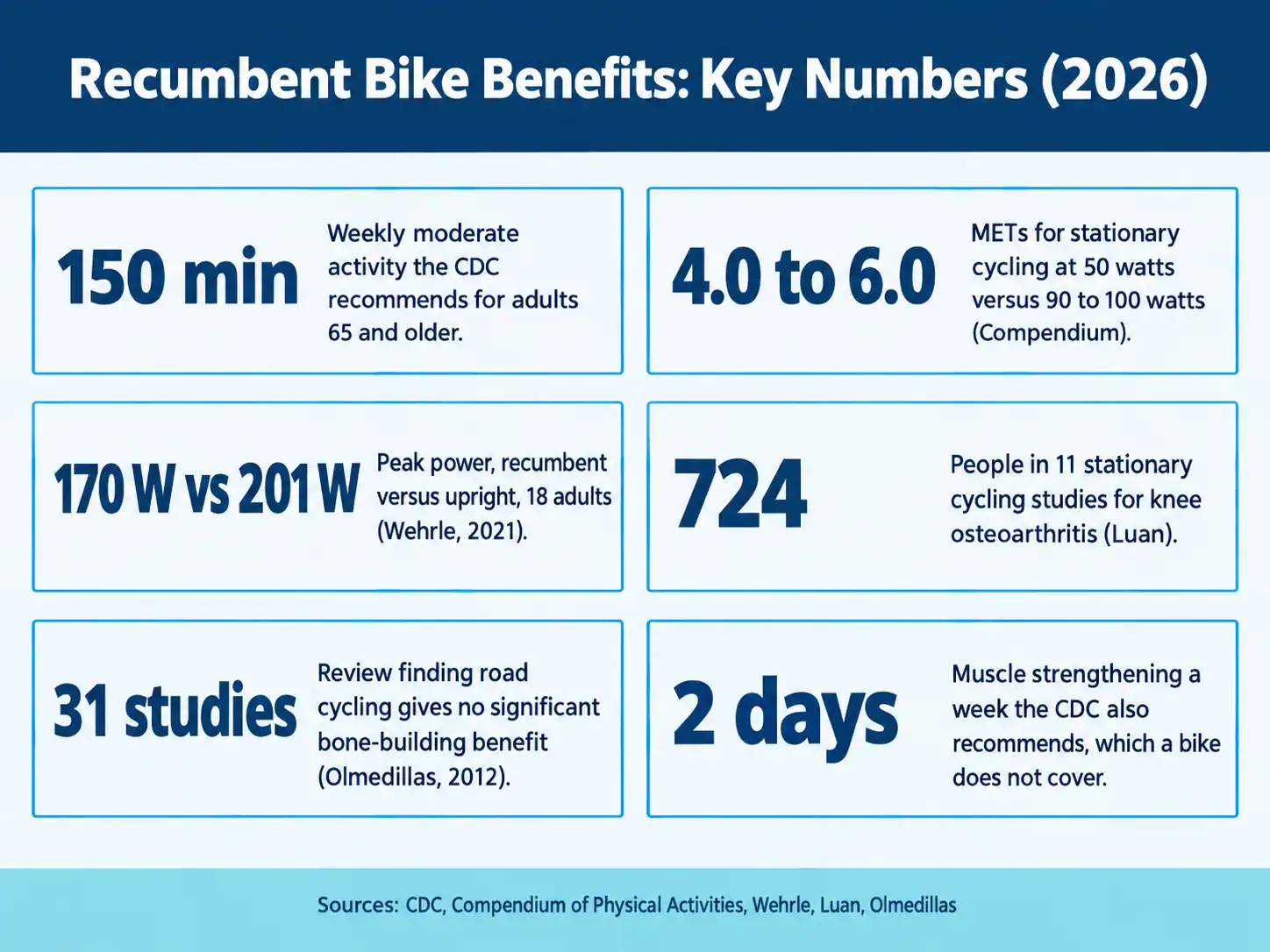
- The CDC recommends 150 minutes of moderate activity a week for adults 65 and older, and lists indoor cycling as an example (CDC).
- Stationary cycling at 50 watts is rated 4.0 METs, and at 90 to 100 watts 6.0 METs. The tables do not list recumbent bikes separately (Compendium of Physical Activities).
- In an 18-person study, recumbent peak power was 170 watts against 201 upright, and peak heart rate was 168 against 170 (Wehrle et al., 2021).
- A meta-analysis of 11 stationary cycling studies with 724 people found less knee osteoarthritis pain, with smaller gains in function (Luan et al.).
- A review of 31 studies found road cycling gives no significant bone-building benefit (Olmedillas et al., 2012).
- I found no trial testing recumbent bikes for back pain, so I treat that benefit as unproven.
- This is information, not medical advice. Check with your doctor first.
A recumbent bike is the exercise machine that looks like a deck chair with pedals. That is also, oddly, the appeal.
Most of what is written about recumbent bike benefits comes from companies selling them. I went looking for the research instead, and found less recumbent-specific evidence than vendor blogs suggest, and more evidence on stationary cycling than you would expect.
What Are the Recumbent Bike Benefits After 50?
The best-supported benefits are aerobic exercise your joints can tolerate and reduced knee pain in people with knee osteoarthritis. Several popular claims, from bone health to back pain, have little or no direct evidence. The table below sorts them.
| Benefit | What supports it | Strength |
|---|---|---|
| Counts toward weekly aerobic target | CDC lists indoor cycling | Strong |
| Knee osteoarthritis pain | Meta-analysis of stationary cycling | Moderate |
| Everyday function | Same meta-analysis, below clinical threshold | Weak |
| Bone density | Reviews of road cyclists say no benefit | None |
| Back comfort | Vendor blogs, no trial found | Unproven |
Confidence level: medium. The evidence is real but mostly about stationary cycling in general. Recumbent bikes are rarely tested on their own, so I assume the findings carry over.
Does a Recumbent Bike Count as Real Exercise?
Yes, if you ride hard enough. The CDC recommends 150 minutes of moderate activity a week for adults 65 and older, such as 30 minutes five days a week; examples include indoor cycling.
Intensity is the catch. The Compendium of Physical Activities rates stationary cycling at 50 watts as light effort, 4.0 METs, and at 90 to 100 watts as moderate to vigorous, 6.0 METs. A MET is a multiple of resting energy use. Pedaling lazily while reading the paper sits at the bottom of that range.
The Compendium doesn’t list recumbent bikes as a separate row, so those figures apply to stationary cycling in general. That is a gap in the data, not a reason to think a recumbent does not count.
Is a Recumbent Bike Easier Than an Upright Bike?
Many people feel it’s easier, and one small study partly explains why. Wehrle and colleagues tested 18 healthy adults, mean age 47, on upright, recumbent and supine bikes to exhaustion. The table shows the medians for the first two.
| Measure at the limit | Upright | Recumbent |
|---|---|---|
| Peak power | 201 W | 170 W |
| Peak oxygen uptake | 35.0 ml/kg/min | 31.6 ml/kg/min |
| Peak heart rate | 170 bpm | 168 bpm |
| Heart rate at lactate threshold | 126 bpm | 115 bpm |
Heart rate at the limit barely changed. Power and oxygen uptake did. The recumbent position hit the ceiling at a lower output, so the same effort shows a lower number on the screen.
The practical point is mine, not the authors’: don’t compare watts across bike types, and judge effort by how you feel and your heart rate. The study was small, healthy, and middle-aged, so it says little about people with heart or lung conditions.
Confidence level: low. One study with 18 people. It helps explain the mechanism, but it is not strong enough to predict how an individual over 50 will respond.
Is a Recumbent Bike Good for Bad Knees?
The evidence is encouraging, but it focuses on stationary cycling, not recumbent bikes specifically. A 2020 meta-analysis in Clinical Rehabilitation pooled randomized trials on stationary cycling for knee osteoarthritis. It included 11 studies and 724 people, pooling 8 studies.
Pain improved by a weighted mean difference of 12.86 (95% confidence interval 6.90 to 18.81). Function improved too, but below the clinical threshold. Quality of life showed no significant change. In plain terms, cycling seems to help pain more than it helps day-to-day function.
A 1999 trial in older adults with knee osteoarthritis adds a useful detail. It put 39 people, mean age 71, on cycle ergometers for 10 weeks, 25 minutes, three times a week, at either 40% or 70% of heart rate reserve. Both groups improved on chair rise, six-minute walk, and pain, and cycling did not raise daily pain in either.
Low intensity did about as well as high. For a nervous beginner, that is the most useful finding here. The page I read did not say whether the bikes were recumbent.
Confidence level: medium. A pooled analysis of randomized trials supports less pain, but the authors report small gains in function, and I could not see their certainty rating. The 1999 trial is older and small. Ask your doctor before starting if you have joint problems.
What Does a Recumbent Bike Not Do?
It does not build bone. A 2012 systematic review of 31 studies in BMC Medicine found fairly conclusive evidence that road cyclists have lower lumbar spine bone density than controls, and the authors concluded that road cycling offers no significant bone-building benefit. They do not recommend cycling alone for people at risk of osteoporosis. If you were hoping for a machine that builds bone, my vibration plate for bone density piece looks at that evidence.
Those were road cyclists, many of them competitive, so I would not read it as “your recumbent bike is thinning your bones.” I found no recumbent-specific bone data. That does mean cycling isn’t your bone plan, which is where my guides on strength training after 50 come in.
It also barely touches strength or balance. The CDC page lists muscle-strengthening on at least two days a week and balance work alongside aerobic activity. A seated, supported bike gives you neither, so pair it with balance exercises and walking.
My walking 2 miles a day and how many steps a day pieces cover the weight-bearing side, and VO2 max by age shows what the aerobic side can buy you.
Does a Recumbent Bike Help With Back Pain?
Maybe, and I cannot prove it. The claim appears all over vendor blogs, and the reasoning is plausible: a backrest and a reclined seat. I could not find a trial that tested recumbent bikes against upright bikes for back pain.
The closest evidence is indirect: a systematic review of eight studies of road cyclists linked low back pain to a flexed spine, core muscle activation imbalances, and back extensor endurance deficits. A recumbent seat avoids that forward-flexed posture, but the review did not test recumbents.
I am not going to call that a benefit on the strength of a product page. If your back hurts, the useful question is which position is comfortable and safe for your diagnosis, and that one belongs to your doctor or physical therapist.
How Long Should You Ride a Recumbent Bike?
Aim at the CDC target and work up to it: 150 minutes a week of moderate activity, for example, 30 minutes on five days. The knee osteoarthritis trial used 25 minutes, three times a week, so a shorter start is well precedented.
Moderate means you can talk but not sing. That is a common rule of thumb, not a finding from the papers above, and it holds across bike types because it relies on effort rather than watts.
If weight loss is the goal, the bike is a tool and not the plan. My lose weight after 50 and lose belly fat after 50 guides cover the rest.
Which Recumbent Bike Should You Buy?
That is a separate question, and I handle it in my best recumbent exercise bike after 50 roundup. If you are still deciding between styles, my best exercise bike after 50 guide covers both, and my home gym after 50 piece covers what else to put in the room.
A bike you ride beats a better one you don’t. The deckchair with pedals has one big advantage over the fancy upright: you might actually sit on it.
Frequently Asked Questions
What are the main benefits of a recumbent bike?
It gives you low-impact aerobic exercise from a seated, supported position. The CDC counts indoor cycling toward the 150 minutes of moderate activity a week it recommends for adults 65 and older, and a meta-analysis of stationary cycling found less knee osteoarthritis pain.
Is a recumbent bike good for bad knees?
The research on knee osteoarthritis is for stationary cycling in general, not recumbent bikes specifically. In that research cycling reduced pain, and in one trial of 39 adults with a mean age of 71 it did not raise daily pain. Talk to your doctor or physical therapist about your own knees.
Is a recumbent bike easier than an upright bike?
It can feel that way, and the numbers partly agree. In one small study, peak power was 170 watts on a recumbent against 201 on an upright, and peak oxygen uptake was lower. Heart rate at the limit was almost the same, so the bikes reach your ceiling at different outputs.
Does a recumbent bike build bone density?
Probably not. A systematic review of 31 studies concluded road cycling gives no significant bone-building benefit, though those studies looked at road cyclists, not recumbent riders. If bone health is your goal, cycling alone is not the plan.
How long should I ride a recumbent bike?
The CDC target is 150 minutes of moderate activity a week, for example 30 minutes on five days. The knee osteoarthritis trial I read used 25 minutes, three times a week, for 10 weeks. Start where your doctor says is safe and build from there.
Does a recumbent bike help with back pain?
I could not find a trial that tests recumbent bikes for back pain. The claim appears on vendor blogs, and the logic of a supported seat is reasonable, but I will not call it a proven benefit. If you have back pain, ask your doctor or physical therapist.
Is a recumbent bike enough exercise on its own?
No. It covers the aerobic part. The CDC also lists muscle-strengthening on at least two days a week and balance work, and a bike gives you very little of either. I cover both in my strength training and balance exercise guides.
Methodology and sourcing. I opened and read these sources on October 26, 2026: the CDC older adult activity page (dated December 4, 2025), the Compendium of Physical Activities bicycling page, Wehrle et al. 2021 in Frontiers in Sports and Active Living, Mangione et al. 1999 in the Journals of Gerontology, Luan et al. in Clinical Rehabilitation Olmedillas et al. 2012 in BMC Medicine and Streisfeld et al. in Sports Health.
Limits: The Mangione page does not say whether bikes were recumbent. Wehrle et al. had 18 healthy participants. The Olmedillas and Streisfeld reviews cover road cyclists. I found no recumbent-specific trial for bone or back pain.
This is an evidence summary, not medical advice. I deliberately excluded vendor claims.
