

Testosterone levels by age have no official normal for each decade. Mayo Clinic Laboratories prints one total testosterone range for all adult men, 240 to 950 ng/dL (8.3 to 33.0 nmol/L). The number that does step down with age is free testosterone.
Key Takeaways
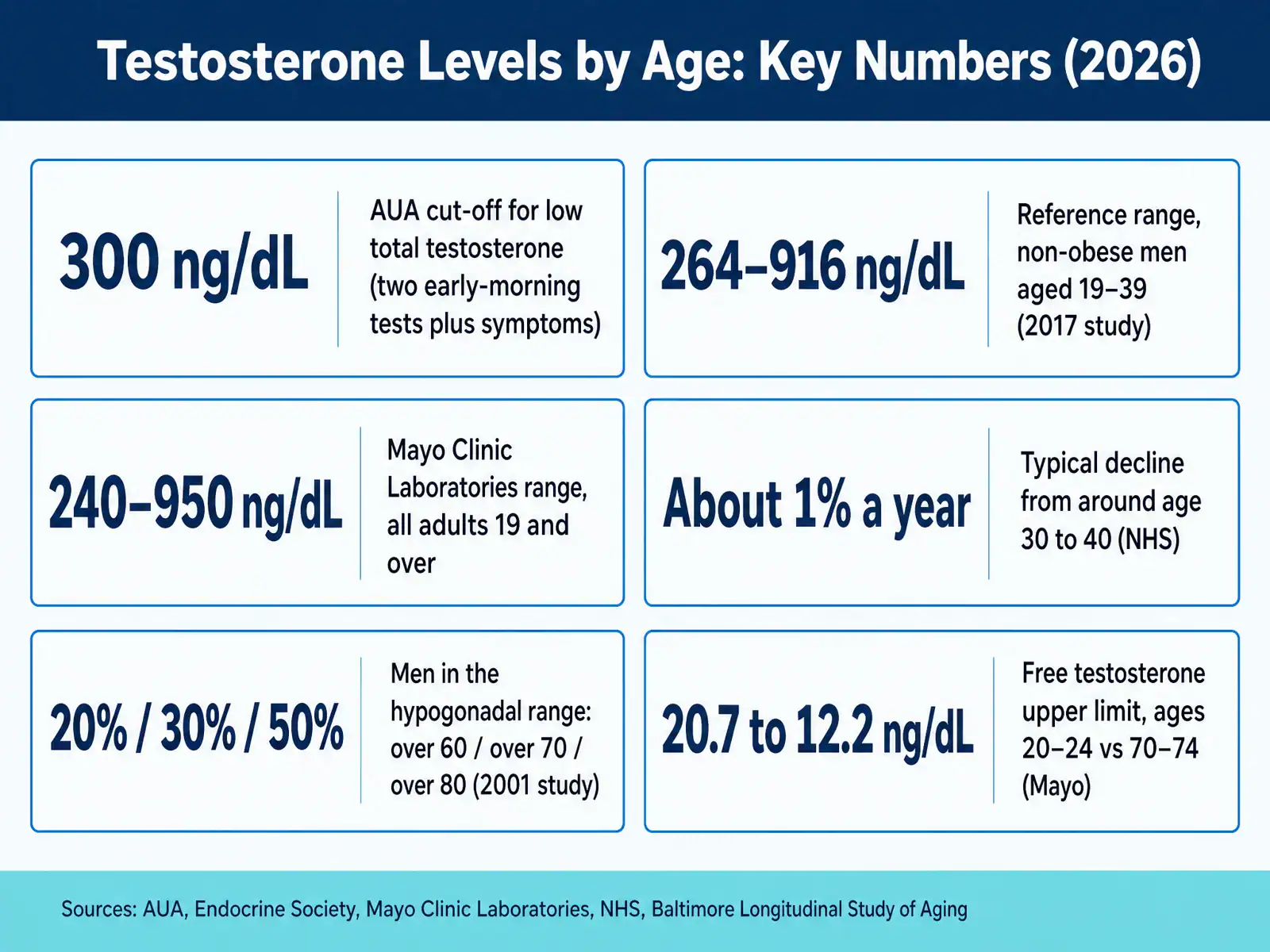
- For testosterone levels by age, Mayo Clinic Laboratories prints one total testosterone range, 240 to 950 ng/dL (8.3 to 33.0 nmol/L), for every adult male 19 and over (Mayo Clinic Laboratories). It doesn’t change by decade.
- The best research range is 264 to 916 ng/dL (9.2 to 31.8 nmol/L), for healthy, non-obese men aged 19 to 39 (Travison et al., 2017).
- The American Urological Association uses 300 ng/dL (about 10.4 nmol/L) as its cut-off for low testosterone, on two early-morning tests plus symptoms (AUA).
- Free testosterone is the age-banded measure. Mayo’s upper limit falls from 20.7 ng/dL at ages 20 to 24 to 12.2 ng/dL at 70 to 74, about 41% lower (my arithmetic).
- The NHS describes a steady decline of about 1% a year from around age 30 to 40 (NHS).
- Test early and more than once. Mayo says early-morning levels in young males average about 50% higher than afternoon levels.
What Are Normal Testosterone Levels by Age?
Search for testosterone levels by age and you get a tidy chart. One neat range per decade, 20s to 70s. I went looking for who measured it. I couldn’t find them.
What I did find is less tidy and more useful. Mayo Clinic Laboratories lists one total testosterone range for adult males 19 and over: 240 to 950 ng/dL. That is the range your lab report is probably using.
The research version is narrower. A 2017 Endocrine Society release reports a harmonized range of 264 to 916 ng/dL, built from healthy, non-obese men aged 19 to 39.
Confidence level: high. Both ranges come from sources I opened and read. Neither is a range for men in their 50s or 60s, which is the point of this page.
Where Does the Testosterone Levels by Age Chart Come From?
That’s the question I couldn’t answer. Many sites publish a testosterone levels by age chart, with a total range for each decade of life. None of the primary sources I opened prints one.
The 2017 release reports its range for ages 19 to 39 only. Mayo uses a single adult range. If a site shows you a 50s row, ask where it came from.
Confidence level: low. Commonly cited, though I could not trace a primary source for age-by-decade total testosterone tables, so I haven’t reproduced any here. That is an absence of evidence from my search, not proof they’re wrong.
| Source | Who it covers | Total T (ng/dL) | Total T (nmol/L) |
|---|---|---|---|
| Mayo Clinic Laboratories | All adult males, 19 and over | 240 to 950 | 8.3 to 33.0 |
| Travison et al., 2017 | Healthy non-obese men, 19 to 39 | 264 to 916 | 9.2 to 31.8 |
| AUA cut-off | Men with symptoms | Below 300 | Below 10.4 |
The nmol/L column is my conversion, using 1 ng/dL = 0.0347 nmol/L. Only the ng/dL figures come straight from the sources.
What Counts as Low Testosterone?
A number alone doesn’t make the call. The AUA guideline calls a total testosterone below 300 ng/dL a reasonable cut-off, and says the diagnosis needs low total testosterone plus symptoms or signs.
It also wants two measurements on separate occasions, both taken in the early morning. That requirement carries the guideline’s strongest grade.
The Endocrine Society takes a similar line. It recommends diagnosing hypogonadism in men with symptoms and signs plus consistently low levels, confirmed by repeating a morning fasting measurement. The summary page I read gives no numeric cut-off.
Confidence level: medium. The AUA threshold is clearly stated. Guidelines still differ on exact cut-offs, and I only read the Endocrine Society’s summary page, not the full text.
Do Testosterone Levels by Age Really Drop?
Yes, gradually. The NHS says the decline is steady at about 1% a year from around the age of 30 to 40, and that it is unlikely to cause problems by itself.
The longer-running data is older. In the Baltimore Longitudinal Study of Aging, 890 men were followed, and total testosterone fell by an average of 0.124 nmol/L a year. That is roughly 3.6 ng/dL a year by my conversion.
The same abstract reports hypogonadal total testosterone levels in about 20% of men over 60, 30% over 70 and 50% over 80.
Two caveats. It’s a 2001 study, and the abstract doesn’t say what threshold it used for hypogonadal.
Confidence level: medium. The direction is well supported. The exact percentages come from one older study whose full text I couldn’t read.
What Are Free Testosterone Levels by Age?
This is the one measure labs do split by age. Free testosterone is the portion not tightly bound to proteins, and Mayo prints a range for each five-year band, using equilibrium dialysis and mass spectrometry.
Here are seven of its bands for free testosterone levels by age. The upper limit falls from 20.7 to 12.2 ng/dL between ages 20 to 24 and 70 to 74, about 41% lower. The lower limit falls by about 38%.
| Age | Lower limit (ng/dL) | Upper limit (ng/dL) |
|---|---|---|
| 20 to 24 | 5.25 | 20.7 |
| 30 to 34 | 4.85 | 19.0 |
| 40 to 44 | 4.46 | 17.1 |
| 50 to 54 | 4.06 | 15.6 |
| 60 to 64 | 3.67 | 13.9 |
| 70 to 74 | 3.28 | 12.2 |
| 80 to 84 | 2.88 | 10.5 |
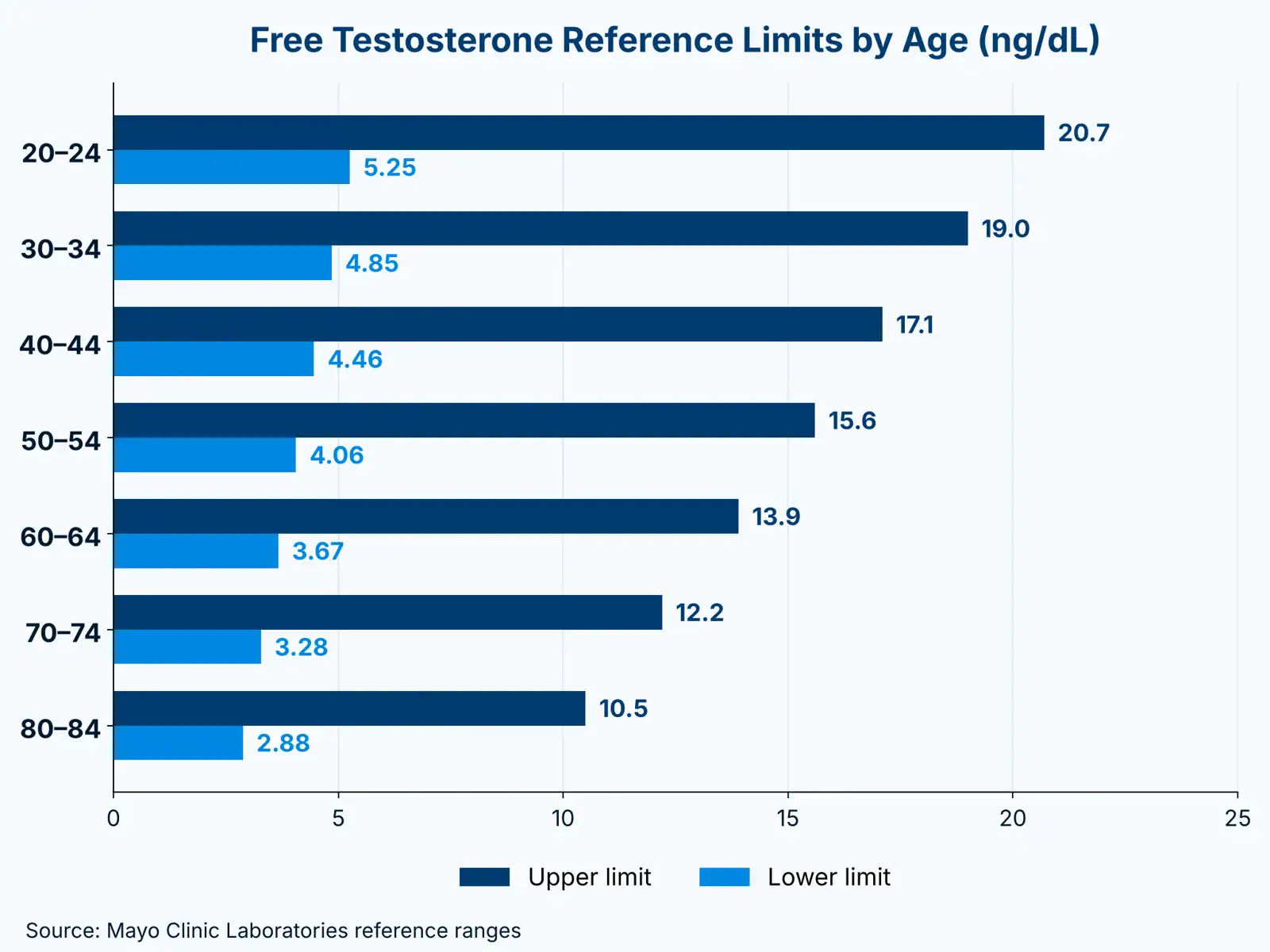
Mayo also prints age-banded bioavailable testosterone. It lists 83 to 257 ng/dL at ages 20 to 29 and 40 to 168 ng/dL at 60 to 69, and has no range established for 70 and over.
Confidence level: high. Every figure in the table is as printed in Mayo’s catalog. The percentage changes are my arithmetic. The listing notes the test is temporarily unavailable, so check the live range with your own lab.
When Should You Test Your Testosterone?
Early in the morning, and more than once. Mayo notes that early-morning levels in young males are on average about 50% higher than afternoon levels, and that levels move from day to day.
That’s why the AUA asks for two early-morning tests. A single afternoon reading tells you much less than it looks like it does.
If you want to see what you’re getting before a doctor visit, I rounded up at-home blood test kits. A kit is a starting point for the conversation, not a diagnosis.
Which Unit Is Your Lab Report Using?
US labs usually report total testosterone in ng/dL. Many other countries use nmol/L. A reading of 12 means something very different in each unit, so check the unit first.
ng/dL and nmol/L converter
Enter a number to convert.
What Should You Do With Your Number?
Take your number to a doctor along with your symptoms. Testosterone levels by age are a guide, not a verdict. The Endocrine Society recommends against routine screening of men in the general population, and suggests against routinely prescribing testosterone to all men 65 or older. Whatever the number says, lifting is the part you control: see strength training for men over 50.
For symptomatic men with consistently low morning levels, it suggests therapy on an individual basis after weighing risks and benefits. The NHS says late-onset hypogonadism is uncommon and more likely with obesity or type 2 diabetes. I compare testosterone therapy with menopausal HRT in HRT pros and cons after 50.
The NHS notes that many symptoms have non-hormonal causes. If sleep is your main complaint, I went through the common culprits in waking up at 3am and alcohol and sleep after 50. If you are trying supplements for sleep, start with magnesium for sleep.
Check the basics before chasing a hormone. My first stop is daily movement, covered in how many steps a day.
If you take several supplements or prescriptions, check how they interact, and see my picks in best vitamins after 50 and the quality supplements guide. More on this philosophy in basics beat biohacks, and the full health hub sits one click away.
Your number sits inside a range. Your doctor’s job is to work out whether you sit inside it comfortably.
Frequently Asked Questions
What are normal testosterone levels by age for a man?
Mayo Clinic Laboratories prints 240 to 950 ng/dL (8.3 to 33.0 nmol/L) for all adult males 19 and over. A 2017 harmonized study of healthy non-obese men aged 19 to 39 reported 264 to 916 ng/dL (9.2 to 31.8 nmol/L). Neither range changes by age.
What is a low testosterone level?
The American Urological Association uses a total testosterone below 300 ng/dL (about 10.4 nmol/L) as a reasonable cut-off. It requires two early-morning tests on separate occasions, plus symptoms or signs, before diagnosing low testosterone. It calls 300 ng/dL a reasonable cut-off, not a hard line, so symptoms and repeat tests matter as much as the number.
What is a normal testosterone level for a 50-year-old man?
No primary source I opened gives a separate total testosterone range for age 50. The same 240 to 950 ng/dL lab range applies to adults 19 and over. Free testosterone is age-banded: Mayo lists 4.06 to 15.6 ng/dL for ages 50 to under 55.
At what age do testosterone levels by age start to drop?
The NHS says the decline is steady at about 1% a year from around the age of 30 to 40. In the Baltimore Longitudinal Study of Aging, total testosterone fell by an average of 0.124 nmol/L a year, roughly 3.6 ng/dL.
What time of day should I test testosterone?
Early morning. Mayo notes that early-morning levels in young males average about 50% higher than afternoon levels, and the AUA requires both of its confirming tests to be early-morning. Levels also vary from day to day, so one reading isn’t enough.
Should every man over 50 get his testosterone checked?
The Endocrine Society recommends against routine screening of men in the general population. It recommends testing men who have symptoms and signs of testosterone deficiency, and confirming a low result with a repeat morning fasting measurement. A man with no symptoms generally has no reason to test, though your own doctor can judge your individual case.
How many men have low testosterone as they age?
In the Baltimore Longitudinal Study of Aging, about 20% of men over 60, 30% over 70 and 50% over 80 had hypogonadal total testosterone levels. That is a 2001 study of 890 men, so treat the percentages as a rough guide.
Methodology and sourcing. I built this page on testosterone levels by age from primary sources I opened and read: the AUA testosterone deficiency guideline (2018, validity confirmed 2024), the Endocrine Society guideline summary (2018), Travison et al. (2017) with its press release, the Mayo Clinic Laboratories test catalog, the Harman et al. (2001) abstract, and the NHS. All pages were accessed on October 13, 2026.
I read only the Harman abstract and the Endocrine Society summary page. Mayo’s listing says the test is temporarily unavailable, so ranges are as printed. I didn’t cover female ranges. All nmol/L figures and percentage changes are my own conversions and arithmetic. Nothing here is medical advice.
