

A vibration plate for bone density has mixed evidence: some meta-analyses find small gains in postmenopausal women, but a 2024 overview of 15 reviews does not recommend it for that purpose.
Key Takeaways
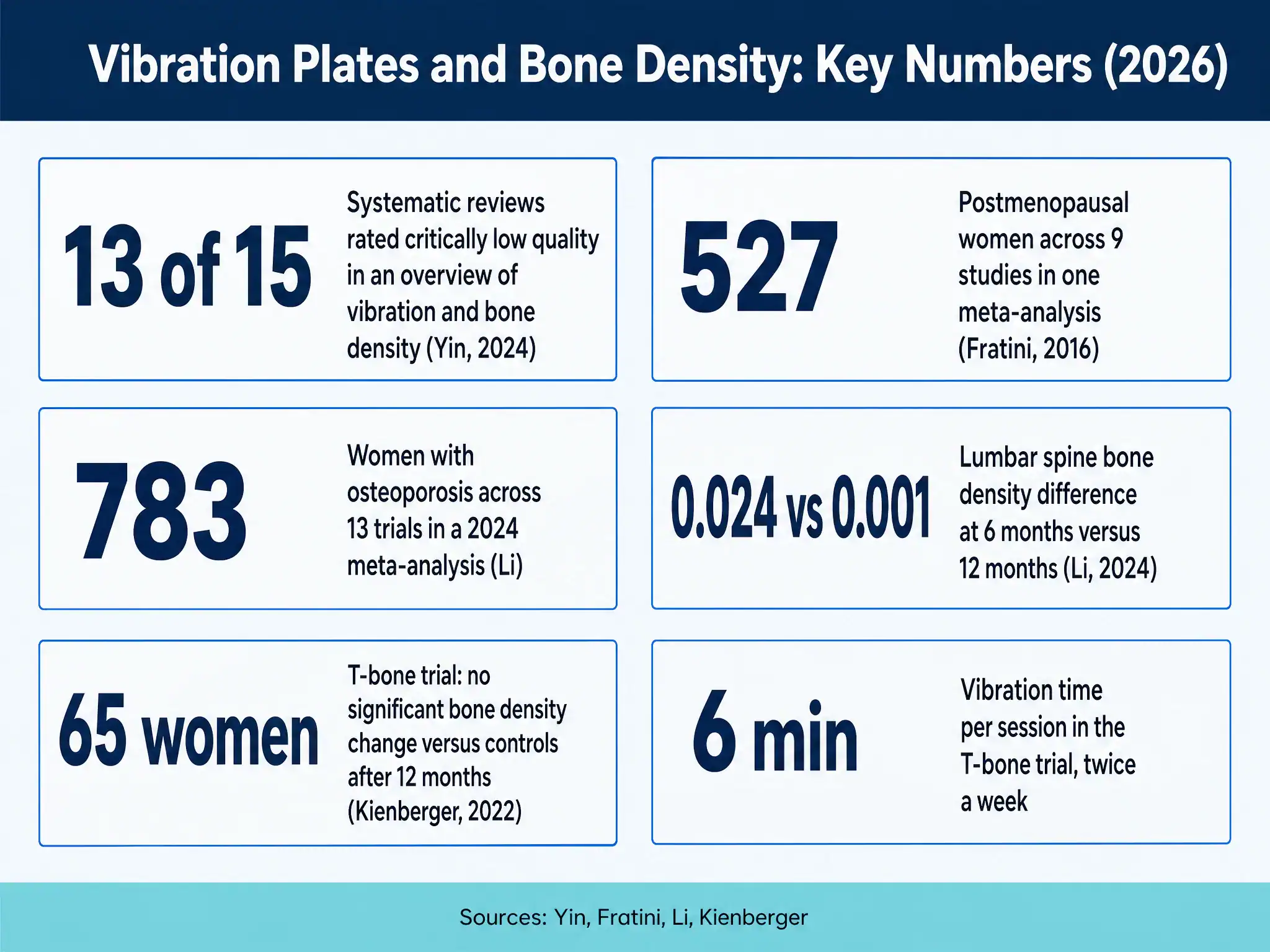
- An overview of 15 systematic reviews found no significant advantage for bone density and did not recommend vibration for it; 13 of the 15 reviews were rated critically low quality (Yin et al., 2024).
- A meta-analysis of 13 trials with 783 women found small gains at 6 months and no significant difference at 12 months (Li et al., 2024).
- A 12-month trial of 65 postmenopausal women found no significant change in bone density versus controls (Kienberger et al., 2022).
- Every study I read covered postmenopausal women. I found nothing on men.
- In the studies I read, no severe side effects were reported. Ask your doctor first, especially with osteoporosis.
- This is information, not medical advice.
Standing still while a machine builds your bones is the most appealing exercise plan ever created. That is exactly why it deserves some scrutiny.
Vibration plates are sold on the promise that tiny shakes tell your skeleton to get stronger. I read five studies on whether that happens in women past menopause, which is where nearly all the research sits. The honest answer is a shrug – with a few numbers attached.
Does a Vibration Plate for Bone Density Work?
Maybe slightly, in some women, for a while. Mmm, not sure that’ll have us queuing around the block! The table lines up what each source found.
| Source | What it covered | Bone density finding |
|---|---|---|
| Fratini 2016 | 9 studies, 527 women | Gains versus no treatment; negligible when added to exercise |
| Ma 2016 | 8 trials, 1,014 women | Small lumbar gain at low magnitude; none at the femoral neck |
| Li 2024 | 13 trials, 783 women | Small gains at 6 months, none at 12 |
| Yin 2024 | Overview of 15 reviews | No significant advantage; not recommended |
| Kienberger 2022 | 1 trial, 65 women, 12 months | No significant change versus controls |
Confidence level: low. The gains that exist are small, short-lived, and come from small trials. I would not bet my bones on them.
Why Do the Reviews Disagree?
Three reasons show up repeatedly. The trials are small; Li and colleagues note that only one of their 13 had more than 100 participants. The protocols differ wildly, from 12.5 to 90 Hz and from 0.3 to 8 g. The reviews also overlap, so they are not independent.
That last point is the heart of the Yin overview. It graded 15 systematic reviews and rated 13 as critically low quality using the AMSTAR-2 tool, with significant overlap in the trials they pooled. The authors concluded they do not recommend vibration to improve bone density in postmenopausal women, though it may help maintain it.
Li and colleagues reached a friendlier verdict and called the included trials good quality. Both can be true: small, decent trials can still add up to a shaky answer. Some controls in those trials also took calcium, vitamin D, or osteoporosis drugs, which muddies the comparison.
Confidence level: high. That the reviews disagree is not in doubt. All of them say so. Which side is right is the part I would call unresolved.
Does the Effect Last?
The pattern in Li 2024 is the most useful single result. Pooled trials showed a significant lumbar spine gain at 6 months and no significant difference at 12 months. Femoral neck followed the same pattern. Differences are as the paper reports them.
| Site | At 6 months | At 12 months |
|---|---|---|
| Lumbar spine | 0.024 (0.009 to 0.039) | 0.001 (-0.006 to 0.007) |
| Femoral neck | 0.024 (0.008 to 0.040) | 0.003 (-0.003 to 0.009) |
The authors suggest this could reflect the patients or their adaptation to the vibration.
Either way, a benefit that fades by the one-year mark is not a bone-building plan. The Harvard Health summary of a 2011 trial points the same way: women who stood on a platform for 20 minutes a day for a year lost as much bone as controls.
Do Particular Settings Work Better?
Fratini and colleagues looked for the key stimulus. They found hints that side-alternating platforms beat synchronous ones, that more than 3 g or less than 25 Hz worked better, and that cumulative time above 1,000 minutes tracked with better outcomes. They also say the adequate level of stimulation has not been defined.
Their cumulative analysis showed no overall difference and very high heterogeneity, with an I-squared of 94%. Subgroup findings from nine small studies are leads for future trials, not instructions for your living room.
The T-bone trial shows how hard the dose question is. It used a side-alternating platform at about 3.2 g and 18 to 20 Hz, but only about 6 minutes of vibration per session, twice a week, for 12 months. By my arithmetic, that is about 624 minutes, below the 1,000-minute mark. Its authors recommend at least 24 months of follow-up.
Confidence level: low. The settings findings come from subgroup comparisons across heterogeneous trials. Treat them as hypotheses.
Is a Vibration Plate Safe After 50?
On the evidence I read, yes, for most healthy people. In the Yin overview, only five of the 15 reviews reported adverse events, and none reported severe ones. The T-bone trial recorded no adverse events linked to the intervention. That is reassuring but thin, because most trials were not designed to look hard for harm.
Your own situation matters more than the averages. If you have osteoporosis, a history of fractures, a joint replacement or any condition affecting balance, ask your doctor or physical therapist before you step on one. That is general caution, not a finding from these papers.
Confidence level: medium. Safety looks fine in the trials, but they were small and short, and women with complicated conditions were less likely to be enrolled.
What Builds Bone Better Than a Vibration Plate?
Two of the reviews open with the same point: drugs, sometimes with exercise, are the established route, and weight-bearing and resistance exercise are the exercise routes. A vibration plate is pitched as an alternative to both. The evidence above says it has not earned that role.
The T-bone trial adds a twist. After 12 months, neither the vibration group nor the resistance training group changed bone density significantly, but resistance training improved quality of life and postural control. Bone density is a slow variable. Strength, balance, and confidence move faster, and they are what keep you off the floor.
My strength training after 50 and balance exercises guides cover that. If you walk, my walking benefits and steps a day pieces are the free option. My home gym after 50 guide covers the gear.
If you want to know where your bones actually stand, a DEXA scan measures it, and my DEXA scan cost guide covers what it costs. Ask your doctor what else belongs in the plan.
Cardio has its own case, and my VO2 max by age guide covers it. If your weight is part of the picture, my lose weight after 50 and midlife weight loss pieces come next. For the supplement shelf, my collagen after 50 guide takes the same evidence-first look.
Confidence level: medium. The ordering of drugs and exercise comes from the introductions of two reviews, not from a head-to-head trial I read.
Should You Buy a Vibration Plate?
If your goal is stronger bones, the research does not justify the purchase. If you want a gentle, low-effort way to add movement and you have your doctor’s approval, a plate is unlikely to hurt, and that is a different goal from the one on the box.
I have not reviewed specific plates for this piece, and I would be wary of any listing that promises osteoporosis results. Spend the money on a pair of dumbbells and some decent walking shoes first. They have a better paper trail.
Frequently Asked Questions
Do vibration plates improve bone density?
Possibly a little, for some women, and the evidence is mixed. Two meta-analyses found small gains in postmenopausal women, while a 2024 overview of 15 reviews found no significant advantage and did not recommend vibration for this purpose. Check with your doctor before relying on it.
Can a vibration plate reverse osteoporosis?
Nothing I read shows that. The trials measure small differences in bone density against control groups, not reversal of a diagnosis. If you have osteopenia or osteoporosis, ask your doctor about proven treatment and treat a vibration plate as an experiment at most.
How long would I need to use a vibration plate?
Nobody has defined a dose. One meta-analysis linked more than 1,000 cumulative minutes to better outcomes, and the T-bone trial used about 6 minutes of vibration, twice a week, for a year. That is roughly 624 minutes by my arithmetic, and it found no significant change.
Is a vibration plate safe after 50?
In the studies I read, serious problems were not reported. In the overview of 15 reviews, only five reported adverse events and none were severe, and the T-bone trial recorded none linked to the intervention. Ask your doctor first if you have osteoporosis, a fracture history or an implant.
Does a vibration plate prevent falls?
The evidence I read is thin. A bone density review mentions trials reporting fewer falls, but I did not read those trials and I would not build a plan on that. Balance and strength work has a clearer track record and costs nothing.
Is a vibration plate better than lifting weights or walking?
No trial I read compared it with walking. In the T-bone trial, neither vibration nor resistance training changed bone density over 12 months, but resistance training also improved quality of life and postural control, and vibration did not.
Does a vibration plate work for men?
I cannot say. Every review and trial I read covered postmenopausal women. I found no evidence for men, so any claim that it builds bone in men goes beyond what I could verify.
Methodology and sourcing. I read the full text of Fratini et al. 2016, Yin et al. 2024, Kienberger et al. 2022 and Li et al. 2024 on October 26, 2026, along with Ma et al. 2016 and the Harvard Health summary of a 2011 trial.
Limits: The 624-minute figure is my arithmetic from the T-bone protocol, not a number the authors report. Every source covers postmenopausal women. I found no evidence for men.
This is an evidence summary, not medical advice. I deliberately excluded vendor claims.
