

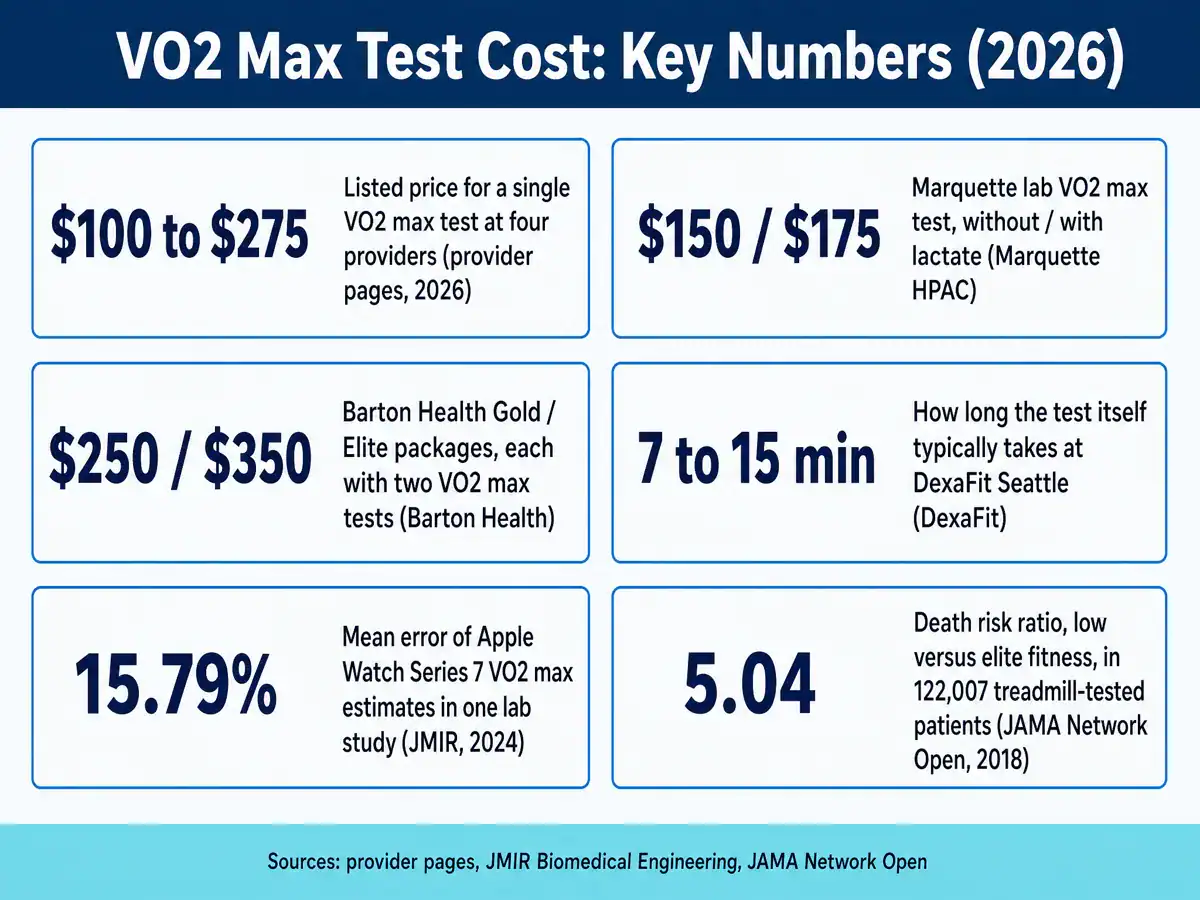
A VO2 max test costs $100 to $275 at the four providers that list a single price, and $150 to $400 at a fifth. Insurance generally will not pay without a medical reason. Free estimates exist, but their error bars are worth knowing.
Key Takeaways
- Single-test prices I verified: $100 (Livingston HealthCare), $150, or $175 with lactate (Marquette), $175 (DexaFit Seattle) and $275 (Sports and Performance Cardiology).
- Fishtown Medicine says typical self-pay is $150 to $400. Barton Health sells packages at $250 and $350, each with two tests.
- Two providers say insurance does not generally cover it without a medical indication (Livingston, Fishtown).
- The test itself takes about 7 to 15 minutes (DexaFit).
- A free heart-rate ratio estimate had about 4.5% error in well-trained men (2004 study). An Apple Watch Series 7 averaged 15.79% error (2024 study).
- My price data covers six providers on one day, so no national average is claimed.
You blow into a tube while someone turns the treadmill up until you want to stop. Then you pay $100 to $275 for the privilege. Surely there is a cheaper way to learn how fit you are.
There is, sort of. This piece covers what the lab test costs, what the money buys, and how far the free estimates can be trusted. I did not take a test for this. Every price below comes from a provider’s own page, opened on October 29, 2026.
VO2 Max Test Cost: What Six Providers Charge
Prices are all over the place because the products are. Some are single tests, some are bundles, and one is a university lab that also tests athletes. Here is every figure I could verify.
| Provider | Price | What the page says | Source |
|---|---|---|---|
| Livingston HealthCare | $100 | Single test; not covered by insurance | Livingston |
| Marquette HPAC | $150 ($175 with lactate) | One-hour appointment; prices updated February 2025 | Marquette |
| DexaFit Seattle | $175 | Test typically takes 7 to 15 minutes | DexaFit |
| Sports and Performance Cardiology | $275 | Out of pocket; 10% off two, 20% off four | SPC |
| Fishtown Medicine | $150 to $400 | “Typical pricing” for self-pay | Fishtown |
| Barton Health | $250 Gold, $350 Elite | Each includes two VO2 max tests and two resting metabolic rate tests | Barton |
The Barton packages are not comparable with the rest. Gold ($250) adds exercise recommendations, and Elite ($350) adds skin fold and circumference measurements plus nutrition guidance. Because they bundle two VO2 max tests with two metabolic rate tests, I cannot split out a price per test.
So the clean range is $100 to $275 for a single test at four providers. Fishtown’s $150 to $400 is the only source that suggests you could pay more, and it is a typical range, not a posted price.
Confidence level: medium. Every price is the provider’s own, read on October 29, 2026. Prices change, and Marquette’s page is dated February 2025.
What Drives the Price Difference?
The page text offers three clues. First, the extras. Marquette charges $25 more for lactate, and lists a $150 resting metabolic rate test separately. Barton’s packages are mostly extras.
Second, the setting. A studio, a university core lab, a physical therapy clinic and a cardiology practice are different businesses with different overheads. My inference: a cardiology practice charging the highest single price is paying for physician oversight. I did not find a page saying so.
Third, the discounts. Sports and Performance Cardiology takes 10% off two tests and 20% off four, if used within a year. That matters if you plan to repeat the test.
Before booking, ask three things: is the price for one test, is a report included, and who supervises a test that takes you to exhaustion?
Sports and Performance Cardiology aims for maximal effort and exhaustion in 8 to 12 minutes. That is hard work, so if you have heart disease risk factors, ask your doctor first. That is my general caution, not a provider claim. If your doctor orders a heart ultrasound instead, echocardiogram cost shows what Medicare pays.
Confidence level: low. The price differences come from my reading of six pages. None of the providers explain their pricing.
Will Insurance or Medicare Pay for a VO2 Max Test?
Probably not. Livingston HealthCare says plainly: “This is not covered by insurance.” Fishtown Medicine says insurance “does not generally cover testing without a specific medical indication.”
That wording matters. A doctor can order a cardiopulmonary exercise test to investigate breathlessness or heart problems, and that is billed differently. I found no price for that kind of test, and I did not find a Medicare coverage page I could read, so I will not guess.
If you are 50 to 64 and between plans, my guide to health insurance before Medicare covers the bigger money question.
Confidence level: medium. Two providers say it is generally not covered. I could not check coverage rules for a medically ordered test.
What Does a VO2 Max Number Tell You?
Quite a lot, if you believe the largest study I found. The Cleveland Clinic followed 122,007 patients who had treadmill tests between 1991 and 2014, with 13,637 deaths. Compared with elite fitness, low fitness carried an adjusted hazard ratio of 5.04 for death from any cause. Below average versus above average was 1.41.
Those are associations in people referred for testing at one clinic, not proof that raising your number saves your life. They are still the numbers I would want my doctor to know.
To read your own result, VO2 max by age has the full tables. For ages 50 to 59 the 2015 FRIEND registry median was 32.6 mL/kg/min for men and 23.4 for women. A 2022 update found treadmill standards 1.5 to 4.6 lower.
Confidence level: medium. The mortality figures come from a peer-reviewed cohort, but they describe associations in one health system among people tested for a reason.
Can You Estimate VO2 Max for Free?
Partly. Two options have published error figures, and neither is a lab test.
The first is a heart-rate ratio. A 2004 study in 46 well-trained men aged 21 to 51 found VO2 max is about 15.3 times your maximum heart rate divided by your resting heart rate. With a measured maximum, error was about 4.5%. With an age-predicted maximum, it was about 7.8%.
An example, my arithmetic and purely illustrative: a maximum of 165 and a resting rate of 62 gives about 41 mL/kg/min. The authors say it needs validating in other groups, so a 55-year-old should treat it as a rough guide.
The second is your watch. In a 2024 lab study of the Apple Watch Series 7 (19 people, ages 18 to 63), the mean error was 15.79%. The lab average was 45.88 and the watch average was 41.37. It overestimated poorly fit people by 3.80 and underestimated the fittest by 12.00.
That is one model and a small sample, so I would not generalize to every watch. My comparisons of Garmin and Apple Watch and Whoop and Garmin cover what each device tracks.
Confidence level: low. Both studies are small, and neither tested our age range: one was well-trained men aged 21 to 51, the other 19 people aged 18 to 63.
Is a Lab Test Worth It?
Once, probably, if you want a real baseline. At $100 to $175 it costs about what a good pair of running shoes does. Twice a year is $200 to $550 at the listed single-test prices (my arithmetic), and that gets expensive for a number you can move only slowly.
How slowly? A 2025 meta-analysis of 87 trials in adults 60 and over found interval training raised VO2 max by an average of 2.46 mL/kg/min. That is real, but smaller than the watch study’s average error of about 6.5 mL/kg/min (15.79% of 41, my arithmetic).
My view: spend the money once for a reference point, then track the trend with a heart-rate ratio or a watch and check it against the lab every year or two. If the numbers disagree wildly, believe the lab.
The training matters more than the testing. See how many steps a day, walking 2 miles a day and strength training after 50. For other tests worth paying for, try DEXA scan cost and at-home blood test kits.
The wider approach is in basics beat biohacks. Nothing here is medical advice.
Frequently Asked Questions
How much does a VO2 max test cost?
Four providers list a single test at $100 to $275. Fishtown Medicine says typical self-pay is $150 to $400, and Barton Health sells two-test packages at $250 and $350. I read every page on October 29, 2026.
Does insurance cover a VO2 max test?
Not generally. Livingston HealthCare says it is not covered, and Fishtown Medicine says insurance does not generally cover testing without a specific medical indication. A test your doctor orders for a medical reason is a separate matter.
How long does a VO2 max test take?
The test itself is short. DexaFit Seattle says it typically takes 7 to 15 minutes, and Sports and Performance Cardiology aims for maximal effort in 8 to 12 minutes. Marquette books a one-hour appointment for the whole session.
Is a smartwatch VO2 max estimate accurate?
Not reliably. One 2024 lab study of the Apple Watch Series 7 (19 people) found a mean error of 15.79%. It overestimated poorly fit people and underestimated the fittest. Treat the number as a trend, not a lab result.
Can I estimate VO2 max for free?
Roughly. A 2004 study found VO2 max is about 15.3 times maximum heart rate divided by resting heart rate. Error was about 4.5% with a measured maximum. It was tested only in 46 well-trained men aged 21 to 51.
What is a good VO2 max after 50?
In the 2015 FRIEND registry the median for ages 50 to 59 was 32.6 mL/kg/min for men and 23.4 for women. A 2022 update found treadmill standards 1.5 to 4.6 lower. My guide has the full tables.
Methodology and sourcing. I opened and read these sources on October 29, 2026: Barton Health, DexaFit Seattle, Livingston HealthCare, Fishtown Medicine, Marquette HPAC, Sports and Performance Cardiology, the 2004 Uth study, the 2024 JMIR study, the 2018 JAMA Network Open study and the FRIEND registry and the 2025 Frontiers meta-analysis. I did not take a test for this article.
Limits: six providers on one day, mostly in the US, is not a national average. Marquette’s prices are dated February 2025. I kept third-party price roundups out as sources, and study details come from publisher pages.
Totals and examples are my arithmetic. Nothing here is medical advice.
