

Why am I waking up at 3am? Because sleep gets lighter and more fragile after 50, and a fixable trigger such as alcohol, a full bladder, apnea, hormones or a worried brain can turn a normal wake-up into a long one.
Key Takeaways
- Older adults wake an average of 3 or 4 times a night because they spend less time in deep sleep, per MedlinePlus. The waking is normal. Staying awake is the problem.
- More than 40% of people with a nighttime awakening have trouble returning to sleep, per a clinical review in StatPearls.
- About half of adults over 65 get up at least once a night to urinate, and about half of people with obstructive sleep apnea have nocturia (StatPearls).
- I found no primary evidence that 3am itself is special. Deep sleep clusters in the first half of the night and REM periods get longer later, per NINDS, so the second half is simply lighter.
- The American College of Physicians gives CBT-I a strong recommendation as first-line treatment for chronic insomnia, on moderate-quality evidence (Annals of Internal Medicine, 2016).
- Run the free checks before buying anything: alcohol timing, bathroom trips, snoring or gasping, and the bedroom.
Why Do I Keep Waking Up at 3am After 50?
You surface at 3:07. Not groggy, just there, as if someone flicked a light on in the next room. The house is quiet, your brain is not, and the clock has already started doing arithmetic on tomorrow.
Short answer: sleep changes with age. MedlinePlus says older people wake an average of 3 or 4 times each night, because they spend less time in deep, dreamless sleep and the shift between sleeping and waking gets more abrupt.
So the waking itself isn’t the malfunction. The trouble starts when you can’t get back under. A clinical review in StatPearls cites studies showing more than 40% of people with a nighttime awakening have trouble returning to sleep.
Confidence level: high. Lighter, more broken sleep with age is among the best-established findings in sleep research. Individual variation is wide, though. NINDS notes that patterns vary significantly even among people of the same age.
Is There Something Special About 3am?
Not that I can prove. Plenty of sites claim 3am is a cortisol spike or an organ-clock hour. I looked for a primary source that puts a hormone or an organ on a 3am schedule and came back empty.
What is documented is the shape of the night. According to NINDS, REM sleep first shows up about 90 minutes after you fall asleep, with longer REM periods later in the session, while deep Stage 3 sleep occurs in longer stretches in the first half.
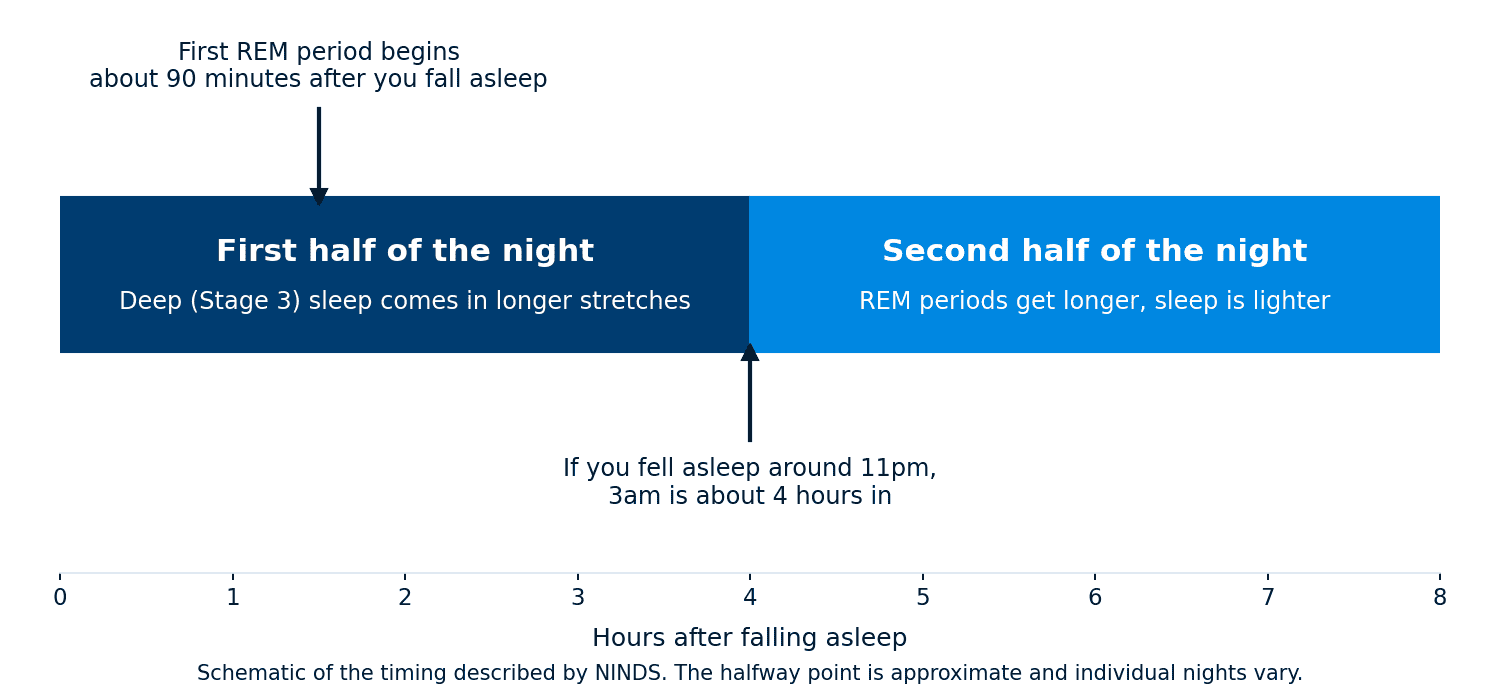
If you fell asleep around 11pm, 3am is roughly four hours in, right around the handover from the deep-sleep half to the REM half. That is simple arithmetic on my part, and individual nights vary.
My reading, and it is only that: 3am falls in the lighter back half of the night, which makes it an easy place to surface. No study I found tests 3am specifically.
Confidence level: low. That 3am has its own hormonal signature. Repeated often online, but I found no primary source for it, and NINDS lists cortisol among sleep-related hormones without a clock time.
What Is Actually Behind Waking Up at 3am?
Six things are worth checking first when you keep waking up at 3am. Use the table as a triage: find the row that sounds like your night, try the first move, then read the page that goes deeper.
| Likely cause | Tell-tale sign | First move | Go deeper |
|---|---|---|---|
| Alcohol | You wake a few hours after evening drinks | Stop drinking 3 to 4 hours before bed, or skip it for a week | Alcohol and sleep |
| Bladder | You wake needing the bathroom, often more than once | Count the trips for a week, then ask your doctor | See “bladder or breathing” below |
| Sleep apnea | Snoring, gasping, or a partner noticing pauses | Tell your doctor what you or your partner see | See “bladder or breathing” below |
| Menopause | Night sweats or hot flashes, then wide awake | Raise it with your doctor | Menopause insomnia |
| Stress loop | Racing mind, clock-watching, dread of waking | Get out of bed; ask about CBT-I | See “what to do at 3am” below |
| Bedroom | Too warm, noisy, or a mattress that has had it | Fix the free stuff, then the mattress | Mattress picks |
Check them in that order. The top of the list costs nothing, and the bottom is where people tend to start spending money.
How Do You Work Out Which Cause Is Yours?
Don’t guess. Keep a one-week log on paper next to the bed. It takes under a minute each morning and turns a vague feeling into a pattern you can act on.
- Bedtime and lights-out time.
- Your last drink and what time you had it.
- Bathroom trips, and what time each one happened.
- When you woke and roughly how long you stayed awake.
- Any snoring or gasping your partner mentioned.
- Anything different: a late meal, extra caffeine, a stressful day, a new medication.
After seven nights, read it back. A 3am wake-up that follows wine every time is a different problem from one that comes with two bathroom trips and a partner’s elbow in your ribs.
If the log points at your bladder or your breathing, take it to your doctor. A page of dates beats “I sleep badly” every time.
Could Alcohol Be Waking You Up at 3am?
Check this one first, because it is the cheapest to test. Alcohol is a sedative, so it gets you under quickly, then wears off a few hours later and your sleep breaks up in the second half of the night.
I went through the research in my post on alcohol and sleep after 50, including why the same two glasses hit harder at 55 than at 35. The sources there put a sensible buffer at three to four hours before bed.
The experiment is simple. Move your last drink earlier, or skip it for a week, and watch whether 3:07 shifts. One week of data beats a month of theories.
Is It Your Bladder or Your Breathing?
Possibly either, and sometimes both. StatPearls reports that roughly half of adults over 65 get up at least once a night to urinate, and that about half of men reporting clinically significant benign prostatic hyperplasia (BPH) have two or more voids a night.
Here is the twist. The same review says nocturia occurs in about 50% of people with obstructive sleep apnea. That means a bathroom trip can be a clue to a breathing problem, not just a bladder one.
NHLBI advice is blunt: if someone tells you that you snore or gasp for air during sleep, talk to your healthcare provider. Medications also matter. StatPearls lists beta-blockers, caffeine, alcohol, and anticholinergics as contributors.
Diabetes and diuretics show up in the same review among the conditions that go with nocturia. If you have no recent bloodwork, at-home blood test kits are a low-friction way to start that conversation. If you take several supplements or prescriptions, check how they interact before blaming your bladder.
Confidence level: medium. The links between nocturia, BPH and apnea are well documented. Which one is driving your nights can’t be settled by an article. That is a job for your doctor.
Does Menopause Change the Answer?
Yes, it is its own chapter. Hormonal shifts during the menopause transition can disrupt sleep, and the fix list differs from the one above.
I covered it separately in menopause insomnia, including what to ask your doctor. Men can skip ahead. Nobody here is going to grade you on attendance.
What Should You Do When You’re Awake at 3am?
If you can’t fall back asleep, get out of bed. NHLBI lists getting out of bed when you cannot sleep as part of stimulus control, one of the core pieces of cognitive behavioral therapy for insomnia (CBT-I), along with going to bed only when you are sleepy.
NHLBI doesn’t put a number on how long to wait, and I won’t invent one. My own rule of thumb, not guideline text: when lying there stops feeling restful and starts feeling like a job, get up.
Skip the clock too. Turning it away from the bed is my own habit, not guideline text, but a glowing number only feeds the arithmetic about tomorrow.
- Move to another room with the lights low.
- Do something dull and offline until you feel sleepy.
- Go back to bed only when you are sleepy, not when you are merely tired.
If this has become a regular pattern, the guideline route is CBT-I before any pill. The American College of Physicians recommends that all adults with chronic insomnia disorder receive CBT-I as initial treatment, a strong recommendation on moderate-quality evidence. Medication is a shared decision, and only if CBT-I alone didn’t work.
Confidence level: high that CBT-I is the recommended first treatment. The ACP rated the evidence moderate, not strong, and that is the honest label.
Do Supplements and Sleep Aids Help With Waking Up at 3am?
Modestly at best. On magnesium, my read of the evidence is a modest, real effect, with the clearest benefit in people who are low in magnesium. It is not a switch.
Melatonin is shakier. NCCIH reports that the AASM (2017) and ACP (2016) guidelines found not enough strong evidence to recommend it for chronic insomnia, and that in older people it may stay active longer, causing daytime drowsiness.
Quality is its own problem. The same page cites a 2023 study finding 22 of 25 over-the-counter melatonin gummies inaccurately labeled. For prescription sleep drugs, NHLBI says benzodiazepines can be habit-forming and should be taken for only a few weeks.
If you are weighing supplements more broadly, the vitamins guide is where I keep that evidence sorted.
Light panels get pitched for sleep as well. I went through the trials in red light therapy for sleep, and the evidence is thinner than the marketing.
Confidence level: medium to low. Evidence for over-the-counter sleep supplements is limited and mixed. Tell your doctor what you take, especially if you are on prescriptions.
Should You Buy a Tracker or a New Mattress First?
Neither, first. If you are waking up at 3am, do the free checks, then spend. A tracker will tell you how often you wake. It won’t tell you why, which is the part you actually need.
If you want the data anyway, I ranked the options in best sleep tracker after 50 and wrote up 12 months with an Oura ring. If your back is what wakes you, the mattress roundup covers six picks across price bands. I also compared it with a band in Whoop vs Oura.
And if the gadget shelf is already full, my case for boring basics over biohacks still applies at 3am.
When Should You See a Doctor About Waking Up at 3am?
See one when waking up at 3am stops being a bad week and becomes a pattern, or when it comes with company. That includes snoring or gasping, regular bathroom trips (StatPearls counts two or more a night in its prevalence figures), heavy daytime sleepiness, or persistent low mood or worry.
Also go if a new medication preceded the change. Your doctor can sort apnea, prostate, diabetes, mood, and medications in one conversation. None of the checks in this guide replace that.
Bring the log, a list of everything you take (prescriptions, supplements, the occasional melatonin gummy), and an honest count of your weekly drinks. Your doctor can only work with what is on the page.
This is information, not medical advice. A sleep problem that has an actual fix deserves the real conversation. The rest of my health writing for this age group lives in the health after 50 hub.
Back to 3:07 for a second. Nobody solves a 3am problem at 3am. That is what the daytime checks are for. Run them, and 3:07 goes back to being a number on a clock.
All My Articles in Sleep, Alcohol, and Recovery:
What Else Do People Ask About Waking Up at 3am?
Is waking up at 3am a sign of something serious?
Usually not on its own. MedlinePlus puts the normal range for older adults at 3 or 4 wake-ups a night. It’s worth a doctor’s visit when it comes with snoring or gasping, frequent bathroom trips, or daytime exhaustion.
Why do I wake up at 3am and can’t go back to sleep?
Sleep gets lighter after 50, so waking is easy, and getting back under is the hard part. A clinical review in StatPearls cites studies showing more than 40% of people with a nighttime awakening have trouble returning to sleep.
Does waking up at 3am mean my cortisol is high?
I couldn’t find primary evidence tying 3am awakenings to a cortisol spike. NINDS lists cortisol among the hormones that shape sleep without giving it a clock time. Treat the claim as unproven.
Should I get out of bed if I wake at 3am?
If you can’t fall back asleep, yes. NHLBI lists getting out of bed when you cannot sleep as part of stimulus control, a core piece of cognitive behavioral therapy for insomnia. It doesn’t name a number of minutes to wait.
Does melatonin help with waking up at 3am?
The evidence is thin. NCCIH reports that the American Academy of Sleep Medicine (2017) and the American College of Physicians (2016) found not enough strong evidence to recommend melatonin for chronic insomnia.
Can alcohol cause waking up at 3am?
Often, yes. Alcohol is a sedative that wears off a few hours after you drink, and sleep tends to fragment in the second half of the night. I covered the mechanism in what wine does to your sleep.
How many hours of sleep do adults need after 50?
NINDS says most adults need 7 to 9 hours, and notes that older adults may have more trouble getting enough. Needs vary a lot between individuals of the same age.
Is waking up to pee at 3am normal?
It’s common. StatPearls reports that roughly half of adults over 65 get up at least once a night to urinate. Common isn’t the same as harmless, though, so a regular pattern is worth raising with your doctor.
Methodology and sourcing. I built this from primary and government sources only: MedlinePlus, NINDS, NHLBI, NCCIH, the StatPearls clinical review of nocturia, and the American College of Physicians guideline in Annals of Internal Medicine (Qaseem et al., 2016). Every number links to the page I read it on.
Where I found no primary source (a 3am cortisol spike, for example), I said so instead of repeating the claim. Where a line is my own reading, I labeled it. Nothing here is medical advice.
