

Whoop vs Apple Watch, short version: buy the Apple Watch if you have an iPhone and want a screen, ECG and alerts for $399 with no membership, and Whoop if you want a screenless band, two weeks of battery and coaching. I wear the Apple Watch, not a Whoop.
Key Takeaways
- Whoop memberships cost $199, $239 or $359 a year with the band included (Whoop). Apple Watch Series 12 starts at $399 with no membership (Apple).
- Over three years the cheapest Whoop costs $597 against $399 for a Series 12 (my arithmetic).
- Whoop claims 14+ days of battery (Whoop). Apple claims up to 24 hours for Series 12 (Apple).
- ECG and on-demand AFib detection sit on the top Whoop tier only, at $359 a year (Whoop).
- In a 2025 sleep-lab study of 62 adults (average age 46), Apple Watch Series 8 agreed with the lab better than Whoop 4.0: kappa 0.53 against 0.37 (Schyvens et al.).
- That study used older models, so it does not settle the Series 12 against the Whoop 5.0 or MG.
Whoop vs Apple Watch is basically a contest between a gadget that tells you the time and a band that only tells you how tired you are. One of them also sends you a bill every year for the privilege.
I used to wear an Apple Watch and have only worn a Whoop for a week. My review is partly first-hand and partly published studies – not what the manufacturers say on their home pages.
What Is the Real Difference Between Whoop and Apple Watch?
Whoop is a strap with no screen. You read everything in its app, and you get it through a membership. The Apple Watch is a full smartwatch that happens to track health, and you buy it once, with no additional fees.
The pitches differ too. Whoop’s is strain, recovery and coaching. Apple’s is a broad health feature list wrapped around a phone companion. Here is how Whoop’s mid-priced tier lines up against the Series 12.
| Feature | Whoop (Peak) | Apple Watch Series 12 |
|---|---|---|
| Cost | $239 a year, band included | From $399, no membership listed |
| Battery (maker claim) | 14+ days | 24 hours, 38 in Low Power Mode |
| Screen | None | Yes |
| ECG | Life tier only ($359) | Yes (age 22+) |
| Sleep | Sleep insights, coaching | Sleep score, apnea notifications |
| Recovery | Recovery and strain | Readiness app, Recovery HRV |
Product sources: Whoop’s site, Apple’s Series 12 page, Apple’s compare page and Apple’s store page. My Whoop needed charging after about 10 days, and my Apple Watch literally every day.

How Much Does Each One Cost Over Three Years?
Whoop looks cheap on day one because the band is included. Apple looks pricey because you pay for the hardware upfront. Over three years the picture flips.
The cheapest Whoop tier is $199 a year, so $597 over three years. Peak is $717 and Life is $1,077. An Apple Watch Series 12 is $399 once, and an SE 3 is $249 (US list prices before tax).
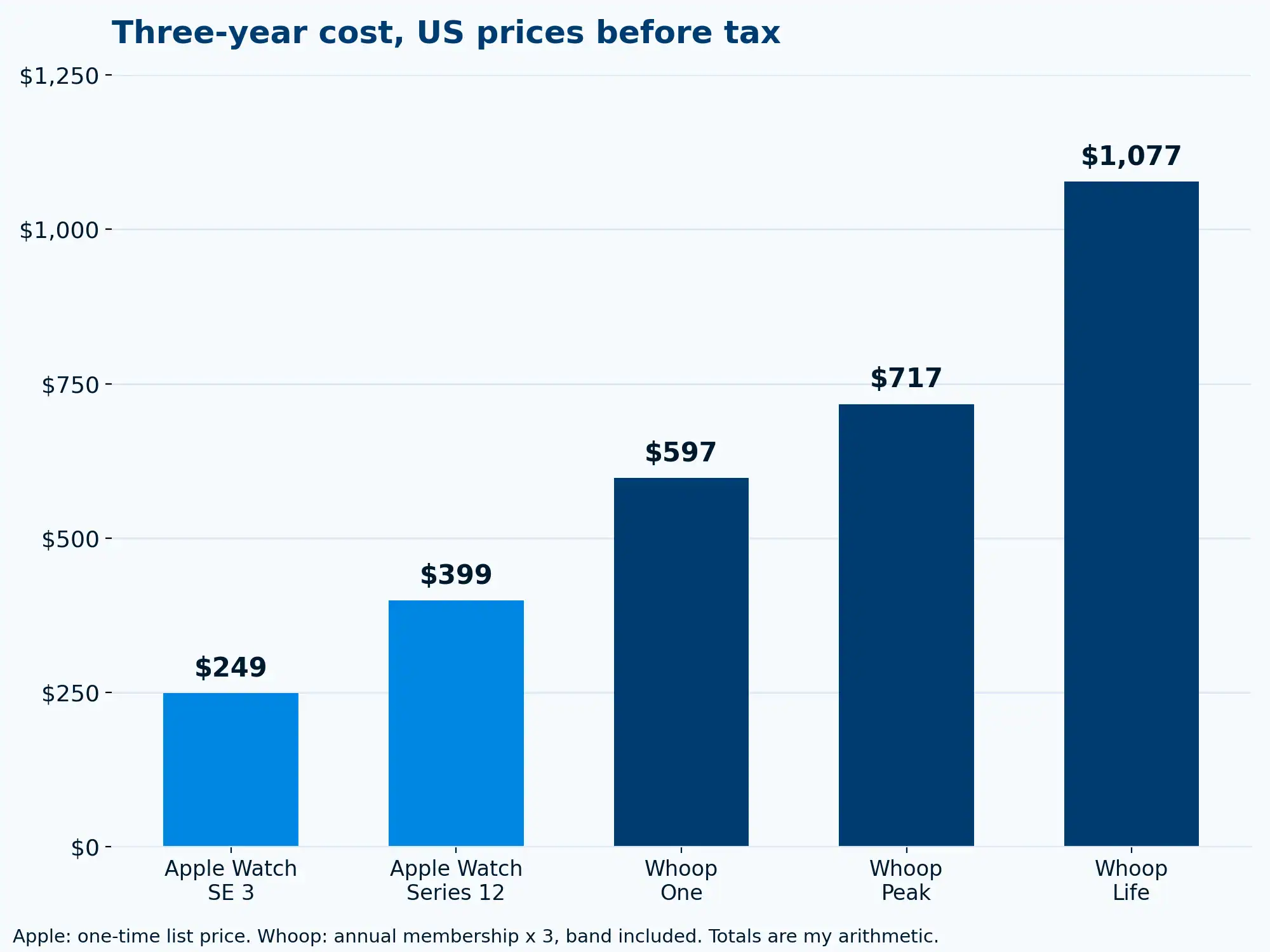
The Apple Watch is not a perfect like-for-like, since it will want replacing sooner or later and the Whoop band gets upgraded within the membership. But on the three-year numbers, Apple wins on price at every tier.
Confidence level: high. These are US list prices from the vendors’ own pages on October 23, 2026. Prices, bundles and discounts change, and Whoop offers add-ons.
What Does Each Whoop Tier Add?
This is where the Whoop bill grows. Per Whoop’s own page, the tiers stack features rather than just changing the price.
| Tier | Per year | What it adds |
|---|---|---|
| One | $199 | Sleep, strain and recovery, coaching, VO2 max, heart rate zones, women’s hormonal insights |
| Peak | $239 | Healthspan and Pace of Aging, health alerts, real-time stress monitor |
| Life | $359 | Blood pressure insights, ECG heart screener, on-demand AFib detection |
Whoop calls the blood pressure feature wellness only, not a medical device. The FDA sent Whoop a warning letter over it in July, 2025, and the agency’s January, 2026 wellness guidance has since eased the line, per a JMIR commentary. I would treat the number as a trend, not a reading.
Apple’s equivalent is simpler: the features are in the box. Series 12 lists Recovery HRV, a Readiness app, sleep score and sleep apnea notifications (Apple). There is no tier to climb.
Confidence level: low. I found no independent testing of Whoop’s blood pressure or ECG features, so I am relying on what Whoop says about them.
Which Is Better for Heart Health After 50?
On price, the Apple Watch. Series 12 lists an ECG app, irregular rhythm notifications and hypertension notifications, from $399 (Apple). Apple says the hypertension feature analyzes optical sensor data over 30 days and is not for under 22s, people already diagnosed with hypertension, or pregnant users.
Whoop puts its ECG and on-demand AFib detection on Life at $359 a year. Whoop says the ECG is not for people under 22, with a pacemaker or other implanted device, or with known arrhythmias other than AFib (Whoop).
Either way, the watch or band can flag a pattern. A doctor decides what it means. If a flag worries you, book the appointment before you buy a better gadget.
Confidence level: low. I found no independent validation of Apple’s hypertension alerts or Whoop’s ECG. Treat both as prompts to ask your doctor, not as diagnoses.
Whoop vs Apple Watch: Which Is More Accurate?
On sleep, Apple has the better evidence, though not for current models. The best head-to-head I could read is a 2025 study of 62 adults, average age 46, who each spent one night in a sleep lab wearing two to four devices. It included an Apple Watch Series 8 and a Whoop 4.0.
| Measure vs sleep lab | Apple Watch S8 | Whoop 4.0 |
|---|---|---|
| Agreement (Cohen’s kappa) | 0.53, moderate | 0.37, fair |
| Awake time detected | 52.15% | 40.13% |
| Deep sleep correctly identified | 50.66% | 69.63% |
| Participants with usable data | 20 (15 missing) | 40 (5 missing) |
Read that as Apple ahead overall and Whoop ahead on deep sleep. Whoop also overestimated deep sleep by about 31 minutes and total sleep by about 24 minutes, while Apple underestimated deep sleep by about 25 minutes. Every device detected more than 90% of sleep. The authors concluded all devices can improve on sleep stages.
An older 2022 Sensors study of 53 adults averaging 25 found a near tie on sleep versus wake (Apple Watch Series 6 88%, Whoop 3.0 86%) and a small Whoop edge on stages (60% against 53%). I give the newer study more weight because it has older adults and later hardware.
A 2024 review in JMIR mHealth and uHealth pooled four Whoop studies of 5 to 53 people each. Whoop caught sleep well (91.7% on average) but spotted wake poorly (56%), with about 62% four-stage agreement, which the reviewers rated as moderate.
The limits matter. The 2025 study was one night, 52 of the 62 were men, and 35 had some degree of sleep apnea. Funding came from a Flemish government innovation agency, and the authors declared no financial interests. Nothing here speaks to heart rate or ECG accuracy at 50 or beyond.
Confidence level: low. One night, 62 adults, mostly men, older hardware and a review of small studies. It says Apple detected waking time better and Whoop deep sleep better in that test, and that wrist sleep stages are rough guides.
Which Has Better Battery Life?
Whoop, by a distance. It claims 14+ days for both the 5.0 and the MG band, with no conditions stated (Whoop). I found that it was more like 10 days, but way ahead of my Apple Watch. Apple claims up to 24 hours for Series 12, or 38 hours in Low Power Mode with sleep tracking included (Apple).
Fourteen days is 336 hours, about fourteen times the Series 12 claim. The gap matters most for sleep tracking. You have to remember to charge your Apple Watch every day, but once you have the habit down it’s fine.
The flip-side of longer battery life is that you can’t get into a routine. It’s easy to forget to charge before bed every 10-14 days.
Confidence level: medium. These are the makers’ own claims. Heavy use, an always-on display and an aging battery all cut the real figure, and Whoop gave no test conditions.
What Have I Tested, and What Have I Not?
I used to wear an Apple Watch. In my Oura Ring review I said Apple wins easily for workouts, notifications and everyday smartwatch chores, and that I prefer the ring for sleeping. (The watch light kept coming on and waking me up.)
I didn’t love wearing my Apple Watch, and swapped it for an Oura Ring. I didn’t love wearing the Whoop either, but I found it more comfortable and less intrusive than the Apple watch.
If you want the ring-versus-band version of this question, my Whoop vs Oura piece covers it. Garmin’s rival band is covered in Whoop vs Garmin, and Garmin vs Apple Watch covers the other pairing.
Who Should Buy Whoop, and Who Should Buy an Apple Watch?
My recommendation if you’re happy wearing a wrist device: the Apple Watch Series 12 for most iPhone owners over 50. It costs less over three years than any Whoop tier, it lists ECG and hypertension alerts without a membership, and it does the phone chores too.
Choose Whoop if you want no screen at all, more comfort, two weeks between charges, or strain and recovery coaching, and you accept a yearly bill. Start at One or Peak, not Life, until an independent test supports the extras.
Skip both if sleep is the only reason you are shopping. My best sleep tracker roundup compares the wider field. (Neither wins!) For why your night goes wrong in the first place, see waking up at 3am and alcohol and sleep after 50.
Whichever you buy, count steps and strength sessions before you count sleep stages. How many steps a day and strength training after 50 will move your numbers more than a new gadget. For my general approach, see basics beat biohacks.
If your device estimates VO2 max, VO2 max by age shows what the number should look like. For the lab behind the wrist, see at-home blood test kits.
For the wider picture, the health hub sits one click away. Nothing here is medical advice.
Frequently Asked Questions
Is Whoop or Apple Watch more accurate?
On most sleep measures, Apple, in the one lab study that tested both. In 62 adults averaging 46, an Apple Watch Series 8 agreed with the sleep lab better (kappa 0.53) than a Whoop 4.0 (0.37) and caught more awake time (52% against 40%). Whoop was better at deep sleep. Neither is a current model.
Do I need a subscription for Whoop?
Yes. Whoop sells membership tiers rather than the band alone: One at $199 a year, Peak at $239 and Life at $359, with the band included. The Apple Watch lists no subscription on the pages I opened.
Which has the better battery life?
Whoop claims 14+ days for both the 5.0 and MG bands, with no conditions stated. Apple claims up to 24 hours for Series 12, or 38 hours in Low Power Mode. Both are the makers’ own figures, so expect less with heavy use.
Does Whoop have ECG like the Apple Watch?
Only on the top tier. Whoop Life, at $359 a year, lists a Heart Screener with ECG readings and on-demand AFib detection. Apple lists an ECG app on Series 12, which starts at $399 with no membership. Neither is a diagnosis.
Can I wear a Whoop and an Apple Watch together?
Nothing I read forbids it, but I have not tried it. It would mean paying for both, and a band on the other wrist is a fair way to learn whether the numbers agree. I would test it for a month before keeping both.
Does the Apple Watch work with Android?
No. Apple says Series 12, Ultra 4 and SE 3 need an iPhone 11 or later running iOS 27 or later. I could not find Whoop’s phone requirements on the pages I opened, so check them before buying.
Which is better for sleep tracking?
Apple had the edge overall in the 2025 lab study, but Whoop was better at identifying deep sleep, catching about 70% of it against 51%. Both are rough guides for sleep stages. For sleep alone, I prefer a ring.
Methodology and sourcing. I opened and read these sources on October 23, 2026. The Apple half is partly first-hand, from my own daily wear. The Whoop half is reported, not tested.
Sources: Whoop’s site, Apple’s Series 12 page, Apple’s compare page, Apple’s store page, the 2025 Schyvens et al. sleep-lab study (full text), the 2022 Sensors study (abstract), the 2024 JMIR review and a JMIR commentary on Whoop’s FDA letter.
Limits: Apple’s pages gave no sleep score scale or validation data for the hypertension alerts.
I kept review sites out as sources. Three-year totals and ratios are my arithmetic. Nothing here is medical advice.
