

Whoop vs Garmin, short version: Garmin’s new Cirqa band is the closest rival to Whoop, costs $199.99 once and needs no membership, while Whoop starts at $199 a year. Choose Garmin for lower cost, Whoop if sleep tracking and its top-tier ECG matter most. I have only worn the Whoop for a week.
Key Takeaways
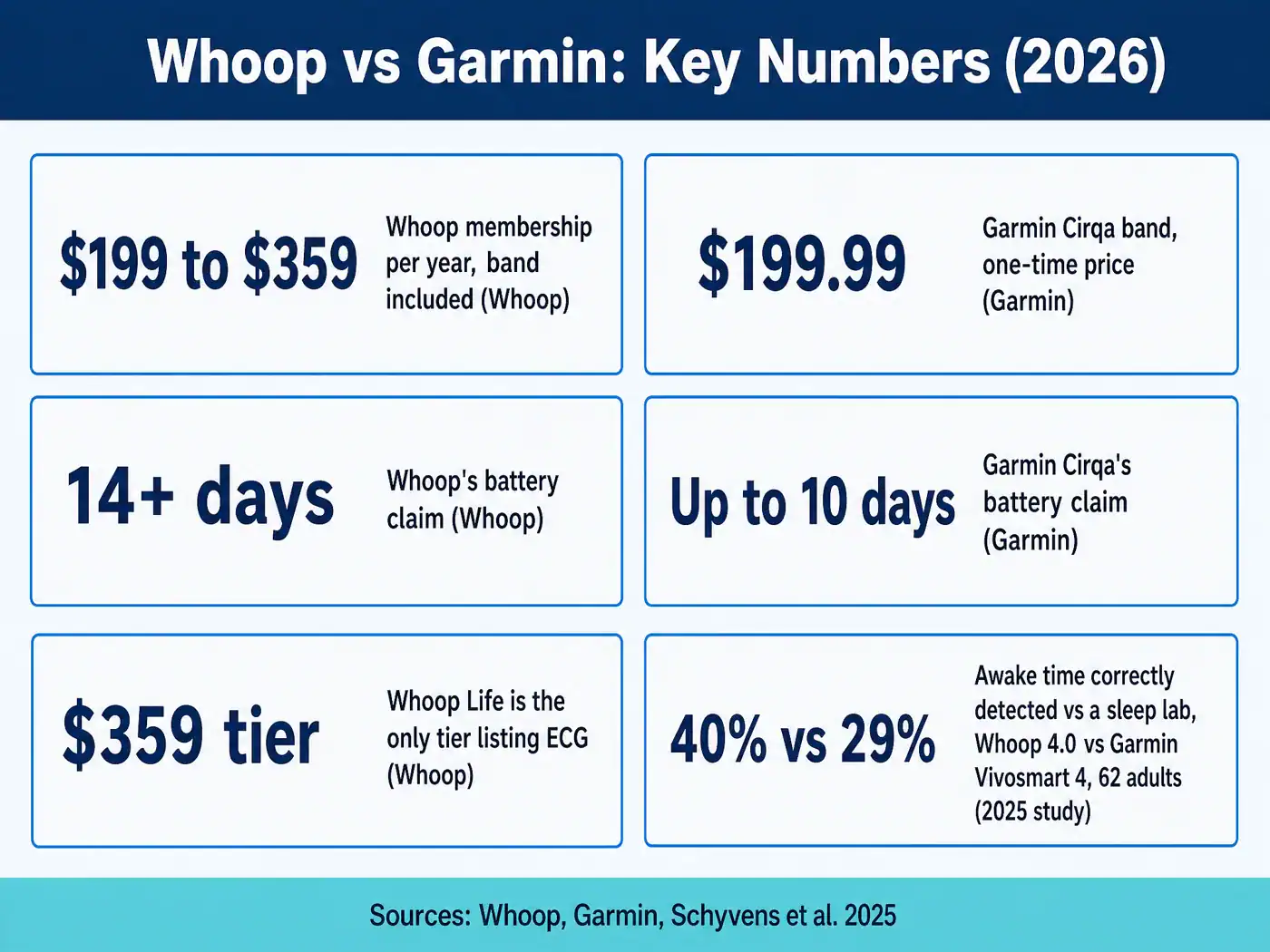
- Whoop memberships cost $199, $239 or $359 a year with the band included (Whoop).
- Garmin’s Cirqa band is $199.99 once, claims up to 10 days of battery and needs no subscription for core features (Garmin).
- Over three years the cheapest Whoop costs $597. A Cirqa costs $199.99, or $409.96 with optional Connect+ (my arithmetic).
- ECG sits on the $359 Whoop Life tier only. Garmin lists no ECG for the Cirqa, but does for the Venu 4.
- In a 2025 sleep-lab study of 62 adults, Whoop 4.0 agreed with the lab better than a Garmin Vivosmart 4: kappa 0.37 against 0.21 (Schyvens et al.).
- That study used older models, and the Cirqa has no lab data I could find.
Whoop vs Garmin used to be a mismatch: a screenless strap you rent against a drawer full of sports watches you buy. Then Garmin built a screenless strap of its own, priced it like a one-off purchase, and left Whoop explaining the subscription.
I used to wear an Apple Watch Series 10 and have only worn a Whoop for just over a week. I have not worn a Garmin, so both halves here are reported from the makers’ own pages, published studies, and reviews. I say which is which as I go.
What Is the Real Difference Between Whoop and Garmin?
Whoop is one product line: a band with no screen that you read in its app, sold only as part of a membership. Garmin is a whole catalog, from watches built around training to the new Cirqa band, which copies the Whoop shape.
So the fair comparison is not Whoop against every Garmin. It is Whoop against the two Garmins a Whoop buyer would actually consider: the Cirqa for the screenless look, and a watch such as the Venu 4 for ECG and a display.
| Feature | Whoop One | Garmin Cirqa | Garmin Venu 4 |
|---|---|---|---|
| Cost | $199 a year, band included | $199.99 once | $549.99 at launch |
| Screen | None | None | Yes |
| Battery (maker claim) | 14+ days | Up to 10 days | Up to 12 days (smartwatch mode) |
| Subscription | Required | Not for core features | Not for core features |
| ECG | Life tier only ($359) | Not listed | Yes (age 22+) |
Sources: Whoop’s site, Garmin’s Cirqa announcement, Garmin’s Venu 4 announcement and Wareable for the no-screen description of Whoop.
How Much Does Each One Cost Over Three Years?
Whoop is cheaper on day one and costlier on day 1,000. The band is included, so the entry price is $199. But the membership renews, and the Garmin hardware doesn’t.

Whoop One is $597 over three years, Peak is $717, and Life is $1,077. A Cirqa is $199.99. With Garmin’s optional Connect+ at $69.99 a year, the Cirqa totals $409.96 (all my arithmetic, US prices before tax).
The crossover is early. In year one, a Cirqa with Connect+ costs $269.98 against $199 for Whoop One. By year two it is $339.97 against $398, and Garmin stays ahead. A Venu 4 with three years of Connect+ comes to $759.96.
Garmin says Connect+ is optional, existing features and data stay free, and a 30-day trial is offered (Garmin). I would definitely skip it until I really missed something.
Confidence level: medium. Whoop’s prices are from its site on October 23, 2026, and Garmin’s are launch prices from 2025 and July 2026 announcements. Retail prices drift, so check both before buying.
What Do You Get at Each Whoop and Garmin Price?
Whoop stacks features by tier. Per Whoop’s own page, here is what each step adds.
| Tier | Per year | What it adds |
|---|---|---|
| One | $199 | Sleep, strain and recovery insights, coaching, VO2 max, heart rate zones, women’s hormonal insights |
| Peak | $239 | Healthspan and Pace of Aging, health alerts, real-time stress monitor |
| Life | $359 | Blood pressure insights (wellness only), ECG heart screener, on-demand AFib detection |
Garmin puts most of the equivalent features in the Cirqa itself. Its launch page lists heart rate, Body Battery, Pulse Ox, stress, skin temperature, HRV, respiration, sleep stages and score, nap detection, training readiness, VO2 max estimates, and cycle tracking (Garmin).
The Cirqa has no screen. It has connected GPS that borrows your phone’s location, and Garmin’s page says it has no GPS of its own. It records activities automatically and lets you start any of 80-plus manually with a side button.
What I cannot judge is whose coaching is better. Whoop’s strain and recovery guidance versus Garmin’s Body Battery and training readiness depends on using both for weeks, which I haven’t done.
Which Is Better for Heart Health After 50?
For ECG, it depends on how much you want to pay. Whoop puts its ECG heart screener and on-demand AFib detection on Life at $359 a year. Whoop says the ECG isn’t for people under 22, those with a pacemaker or other implanted device, or those with arrhythmias other than AFib (Whoop).
Garmin’s Cirqa page lists no ECG and says Pulse Ox is not a medical device. The Venu 4 lists an ECG app that can detect atrial fibrillation or normal sinus rhythm for adults 22 and over, but not in all regions (Garmin).
So if ECG is the reason you are buying, a Garmin watch with ECG costs less over three years ($549.99 vs. $1,077 for Whoop Life), though it costs more up front. Whoop also calls its blood pressure insights wellness only. I would treat that number as a trend, not a reading.
Confidence level: low. I found no independent validation of Whoop’s ECG or blood pressure insights, or of the Venu 4 ECG. A band can flag a pattern. It cannot diagnose anything, so a worrying flag goes to your doctor, not to a bigger gadget.
Whoop vs Garmin: Which Is More Accurate?
On sleep, Whoop has the better evidence, though not for current models. The best head-to-head I could read is a 2025 study of 62 adults, average age 46, who each spent one night in a sleep lab wearing two to four devices. It included a Whoop 4.0 and a Garmin Vivosmart 4, an older basic band.
| Measure vs sleep lab | Whoop 4.0 | Garmin Vivosmart 4 |
|---|---|---|
| Agreement (Cohen’s kappa) | 0.37, fair | 0.21, fair |
| Sleep detected (sensitivity) | 93.58% | 95.92% |
| Awake time detected | 40.13% | 29.39% |
| Participants with usable data | 40 (5 missing) | 25 (18 missing) |
Read that carefully. Garmin was slightly better at spotting sleep. Whoop was better at spotting the awake time during the night, which is the harder part. Whoop also identified 69.63% of deep sleep correctly. I have no matching deep sleep figure for the Garmin.
An older 2022 Sensors study of 53 adults averaging 25 found sleep-versus-wake agreement of 86% for the Whoop 3.0 and 89% for a Garmin Forerunner 245, so on that measure Garmin edged it. The newer study has older adults and later hardware, so I weight it more.
Wareable’s testers, in a comparison I could not date, say Garmin’s sleep tracking has improved but may overestimate sleep and miss wake-ups Whoop catches. They also say Whoop’s wrist heart rate struggles against Garmin’s, and wearing it on the upper arm helps.
The limits matter. The study was one night, 52 of the 62 were men, and 35 had some degree of sleep apnea. Device groups were small and unequal. Funding came from a Flemish government innovation agency, and the authors declared no financial interests.
The Cirqa is brand new, and I couldn’t find any lab data. BGR, relaying other outlets, reported a step count about 16% off in one short walk and good heart rate agreement against a chest strap (BGR). That is a handful of anecdotes, not validation.
Confidence level: low. One night, 62 adults, mostly men, older hardware and unequal samples, plus a review site I could not date and secondhand Cirqa reports. It says Whoop caught more waking time than an old Garmin band, not that a Whoop 5.0 beats a Cirqa.
Which Has Better Battery Life?
On paper, Whoop. It claims 14+ days for both the 5.0 and the MG (Whoop). Garmin claims up to 10 days for the Cirqa, up to 12 for the Venu 4 in smartwatch mode, and up to 11 for the Vivoactive 6 (Garmin).
Fourteen days is 1.4 times the Cirqa’s claim. That gap is real but small compared with the Apple Watch, which needs daily charging. Both bands should leave you charging once a week or two.
The catch is that the claims are best-case. Wareable’s testers reported typically seeing 5 to 7 days from the Whoop, and Garmin’s “up to” 10 days came with no stated conditions.
Confidence level: low. Both figures are makers’ claims, and the only independent number is one review site’s report of 5 to 7 days for Whoop. I found no independent Cirqa battery test.
What Have I Tested, and What Have I Not?
I used to wear an Apple Watch Series 10. In my Oura Ring review I said I prefer a ring for sleep, and that is still my preference. I have never worn a Garmin, and only worn a Whoop for about a week.
A hands-on test would need weeks of nightly wear, ideally a Whoop on one wrist and a Cirqa on the other. Until I’ve done it, treat every claim about comfort, apps, alarms, and support here as reported, not tested.
If you want the ring-versus-band version of this question, my Whoop vs Oura piece covers it, and the wider field is in my best sleep tracker roundup. For the other two pairings, see Whoop vs Apple Watch and Garmin vs Apple Watch.
Who Should Buy Whoop, and Who Should Buy Garmin?
My recommendation: on paper, the Garmin Cirqa for most people over 50 who want a screenless sleep-and-recovery band. It costs $199.99 once, and over three years it is the cheapest option on this page. That rests on price and the maker’s pages, not on any test of mine.
Choose Whoop One if sleep detection is the priority and you do not mind paying every year, since it has the better lab result of the two older models. Choose Whoop Life only if you want ECG in a band, though over three years a Garmin watch with ECG costs less.
Choose a Garmin watch like the Vivoactive 6 at its $299.99 launch price if you want a screen and phone notifications, too. The honest warning on the Cirqa: it is new, reviews are still arriving, and nobody has published a sleep-lab test of it yet.
Skip all of them if sleep is the only reason you are shopping. My guides to waking up at 3am and alcohol and sleep after 50 cost nothing and will move your numbers more than a new band.
Whichever you pick, count steps and strength sessions before sleep stages. How many steps a day and strength training after 50 help more than the hardware. For the bigger picture, see basics beat biohacks.
If your device estimates VO2 max, VO2 max by age shows what a good number looks like. For the lab behind the wrist, see at-home blood test kits and the health hub.
Nothing here is medical advice, and the band will not mind if you ignore it.
Frequently Asked Questions
Is Whoop or Garmin more accurate?
On sleep, Whoop in the one lab study that tested both. In 62 adults, a Whoop 4.0 agreed with the sleep lab better than a Garmin Vivosmart 4 (kappa 0.37 against 0.21) and caught more awake time. Both are older models, and the new Garmin Cirqa has no lab data I could find.
What is Garmin’s version of Whoop?
The Cirqa Smart Band, announced July 21, 2026. It is a screenless band at $199.99 with up to 10 days of battery, wrist or upper-arm wear, and no subscription needed for its health and fitness features. Garmin’s older sleep-only armband, the Index Sleep Monitor, is a separate product.
Does Whoop require a subscription?
Yes. The band comes with the membership, at $199, $239 or $359 a year depending on tier. I did not find a way to buy a Whoop band outright on Whoop’s page, so treat the membership as the only route in.
Does Garmin require a subscription?
Not for the Cirqa’s core features, and Garmin says so. Garmin Connect+ is optional, at $6.99 a month or $69.99 a year, and Garmin says existing features and data stay free.
Does the Garmin Cirqa have ECG?
Garmin’s launch page lists heart rate, Pulse Ox, skin temperature, stress and HRV, but no ECG. Garmin says Pulse Ox is not a medical device. If you want ECG on a Garmin, the Venu 4 lists an ECG app, and on Whoop it sits on the $359 Life tier.
Which has better battery life, Whoop or Garmin?
Whoop claims 14+ days. Garmin claims up to 10 days for the Cirqa, up to 12 for the Venu 4 and up to 11 for the Vivoactive 6. One review site’s testers saw 5 to 7 days from the Whoop, so treat all of these as best-case claims.
Can I wear Whoop and a Garmin together?
Yes, and the reviewers at Wareable call the pairing ideal for serious athletes if the budget allows. For most people over 50 it is more data and more bills than a decision needs.
Methodology and sourcing. Done on October 23, 2026: Whoop’s site, Garmin’s Cirqa announcement (July 21, 2026), Venu 4 and Vivoactive 6 announcements, Garmin Connect+ announcement, the 2025 Schyvens et al. sleep-lab study (full text), the 2022 Sensors study (abstract), Wareable’s comparison and BGR’s Cirqa vs Whoop piece.
Limits: I have worn neither device for long, so the comparison is reported, not tested. Whoop’s page did not state water resistance or phone requirements. Wareable’s piece was undated, and BGR’s test results are secondhand.
Three-year totals, crossover points, and the battery ratio are my arithmetic. Nothing here is medical advice.
