

At home blood test kit — worth it? Usually, if it uses a CLIA- or CAP-accredited lab: I compared five (Labcorp OnDemand, Everlywell, LetsGetChecked, myLAB Box, Choose Health) on price, accuracy, and what they test.
Key Takeaways
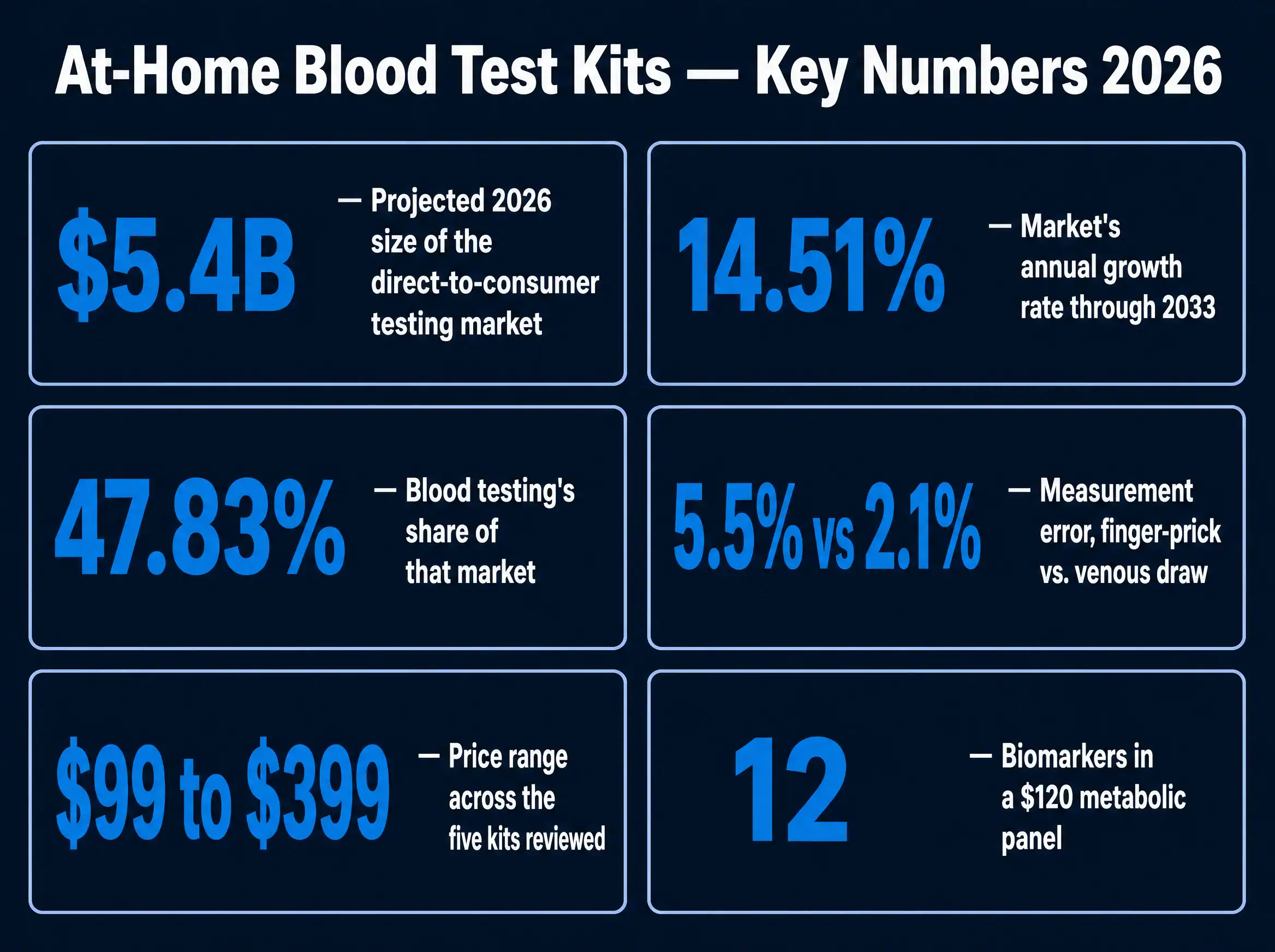
- The direct-to-consumer lab testing market hit $4.7 billion in 2025 and is projected to reach $5.4 billion in 2026, growing 14.51% a year through 2033. Blood testing is the single largest segment, at 47.83% of the market (Grand View Research).
- Four of the five kits I reviewed use finger-prick capillary samples only. Labcorp OnDemand is the exception: you can use a home kit or walk into a Patient Service Center for a full venous draw, the method your doctor’s office uses.
- A peer-reviewed comparison found finger-prick and vein-draw blood produced statistically similar average readings, but finger-prick samples carried more than double the measurement error, 5.5% versus 2.1% (PMC).
- New York’s direct-access testing law only permits self-ordered lab tests that mirror an FDA-cleared over-the-counter kit, which is why several biomarker panels, including some in this review, aren’t sold there (New York State Department of Health).
- The FDA doesn’t review most “general wellness” at-home tests before they reach the market. Oversight instead runs mainly through CLIA, the federal law governing the labs themselves, not the company selling the kit (FDA).
- Prices in this review ranged from $99 for myLAB Box’s single-marker inflammation test to $399 for Labcorp’s most comprehensive panel. Biomarker count, not brand name, explains most of that gap.
- None of the five companies bill your insurance directly. You’re paying cash or FSA/HSA funds no matter which one you pick (Association for Diagnostics & Laboratory Medicine).
Google “at home blood test kit” and you get Labcorp, a testing-services aggregator, and a company most people have never heard of. No health publisher, no doctor’s blog, nobody defending the term with an actual opinion.
That’s usually a sign the honest version of the answer hasn’t been written yet. So here it is: five kits, checked against their own current pricing, actual lab certification, and what happens after your results land, rather than what the marketing copy promises.
What Makes a Good At Home Blood Test Kit?
Four things separate a legitimate kit from a wellness-brand gimmick: where the lab is accredited, how clearly the panel is listed, how long results actually take, and what support exists once you get them.
Every legally operating lab in the US, home-testing or not, must hold CLIA certification: a federal floor covering staff qualifications, proficiency testing, and quality control. CAP accreditation goes further. It’s voluntary, but it adds a stricter, more frequent inspection cycle on top of the CLIA baseline.
I picked these five because they’re the ones actually competing for this exact search. Labcorp OnDemand, myLAB Box, and Choose Health already show up on the first page of Google. And then Everlywell and LetsGetChecked are the two largest national brand names in the category, so it made sense to add them, too.
How Accurate Are At-Home Blood Test Kits?
Accuracy here really means two separate questions: is the lab reliable, and is a finger-prick sample as good as a vein draw?
On the lab side, the answer is reassuring. CLIA and CAP labs run the same proficiency testing regardless of whether the sample arrived by mail or was drawn on the premises (by a phlebotomist – when I grow up, I want to be a…). So, a finger-prick sample analyzed in an accredited lab isn’t run on lesser equipment.
On the sample side, it’s more nuanced. A study comparing capillary and venous blood found the two methods produced statistically indistinguishable average results for hemoglobin mass.
But capillary sampling carried a 5.5% typical measurement error against 2.1% for venous blood, and flagged contamination risk from interstitial fluid and hemolysis (when red blood cells break) during collection (PMC).
Confidence level: moderate. Finger-prick testing is accurate enough for most standard biomarkers on average, but a single reading carries more noise than a lab draw. Treat one abnormal at-home result as a reason to retest, not a diagnosis.
The 5 At-Home Blood Test Kits Worth Considering
These aren’t ranked best to worst. Each one wins on a different axis, and I’ve said who each one is actually for.
Labcorp OnDemand
Labcorp is the reference lab your doctor’s office already uses, which makes it the one name on this list you don’t have to take on faith. It’s also the only provider here offering a genuine venous-draw option: order online and either collect a finger-prick sample at home or walk into a Labcorp Patient Service Center for a standard blood draw.
Panels run from a $29 Complete Blood Count up to a $399 Advanced Health Panel, with a Standard Health Test at $99 and a Comprehensive Health Test at $189 in between. Results post within 1-2 days of the lab receiving your sample, and Labcorp contacts you by phone or mail for anything requiring attention (Labcorp OnDemand).
Best for: someone who wants the least wellness-startup-feeling option, and doesn’t mind a mostly self-serve results portal instead of a built-in consult.
Everlywell
Everlywell runs the broadest catalog of the five, spanning hormone, thyroid, fertility, and general wellness panels under one brand, so you’re not juggling logins across five different companies for five different questions.
Its Women’s Health Test ($249) measures 10 biomarkers, including estradiol, progesterone, LH, FSH, DHEA, cortisol, TSH, free T3, free T4, and TPO, via finger prick plus a saliva sample. Everlywell uses a CLIA-certified lab, results are physician-reviewed, and the test is FSA/HSA eligible, with an optional virtual visit for follow-up (Everlywell).
Best for: someone who’d rather stick with one brand across several different panels than piece together separate providers.
LetsGetChecked
LetsGetChecked leans hardest into an actual care pathway rather than a results PDF. Its home cholesterol test measures triglycerides, total cholesterol, HDL, LDL, and HDL percentage from a fasting, weekday-morning finger-prick sample, run through labs the company describes as CLIA- and ISO-certified, the same tier used by primary care providers and hospitals.
Results arrive in 2-5 days, backed by a clinical support team the company says is 30-plus people. If something needs treatment, a $39 virtual consult can lead straight to a prescription sent to your pharmacy, which none of the other four kits here offer outright (LetsGetChecked).
Best for: someone who wants a real next step already built in if a result comes back abnormal, not just a number to Google at 2am.
myLAB Box
myLAB Box is the budget, single-marker option. Rather than one big panel, it sells 50-plus focused tests you buy individually, which is useful if you only actually want an answer to one question.
Its Inflammation Test ($99) checks high-sensitivity CRP and vitamin D from a finger-prick sample, processed at CLIA- and CAP-accredited labs, with results in 2-5 days and a free phone consult with an in-state physician if anything comes back positive. It’s also, at the time of writing, temporarily unavailable in New York (myLAB Box).
Best for: someone who wants to check one or two specific markers cheaply, not buy a full panel to get there.
Choose Health
Choose Health is the newest name here, and the one with the least brand recognition, which is exactly why it’s earning organic search traffic ahead of bigger consumer names.
It also runs a white-label testing service for practitioners and clinics alongside its consumer panels, which reads like a company that’s spent its money on lab capacity instead of marketing.
Its Comprehensive Metabolic Panel ($120) covers 12 biomarkers, including electrolytes, liver enzymes, kidney markers, and glucose, from a 4-5 drop finger-prick sample. Testing runs through CAP- and CLIA-accredited labs, with results in 3-4 days. The full catalog covers roughly 100 biomarkers across metabolic, liver, kidney, thyroid, and hormone panels, backed by a money-back guarantee (Choose Health).
Best for: cost-conscious buyers who want the most biomarkers per dollar and don’t need a household-name brand attached.
At-Home Blood Test Kits Compared
| Kit | Example Test (Price) | Turnaround | Best For |
|---|---|---|---|
| Labcorp OnDemand | CBC, $29 – Advanced Panel, $399 | 1-2 days | A real venous-draw option |
| Everlywell | Women’s Health Test, $249 | A few days | One brand, many panels |
| LetsGetChecked | Cholesterol Test ($39 virtual consult) | 2-5 days | Built-in clinical follow-up |
| myLAB Box | Inflammation Test, $99 | 2-5 days | Cheap, single-marker checks |
| Choose Health | Comprehensive Metabolic Panel, $120 | 3-4 days | Most biomarkers per dollar |
Which At-Home Blood Test Kit Should You Choose?
Want a real vein draw instead of a finger prick? Labcorp OnDemand is the only one of the five that offers it.
Want one brand covering hormones, thyroid, and general wellness under a single login? Everlywell‘s catalog is the broadest.
Worried about what happens if a number comes back abnormal? LetsGetChecked builds a consult and prescription pathway directly into the process.
Just want to check one thing, cheaply, without committing to a big panel? myLAB Box‘s single-marker tests start at $99.
Want the most biomarkers for your money and don’t care about brand recognition? Choose Health‘s $120 metabolic panel covers 12 markers most competitors charge more for.
Are At-Home Blood Test Kits Regulated?
Yes, but not the way most people assume. The FDA reviews some direct-to-consumer tests before they reach the market, particularly higher-risk ones like genetic health-risk or cancer-predisposition tests. Most “general wellness” biomarker panels, the kind reviewed here, generally skip that premarket review entirely (FDA).
The real oversight sits with CLIA, which regulates the lab processing your sample, not the company marketing the kit or its website claims. The Association for Diagnostics & Laboratory Medicine, the professional body for lab scientists, backs consumer-ordered testing only through CLIA-certified labs, and flags deceptive wellness marketing and result misinterpretation as the real risks here (ADLM).
Confidence level: high. CLIA certification is a genuine, legally required floor for every lab in this review. It’s a real safeguard on the lab’s process. But it says nothing about whether a company’s marketing claims about what your results mean are accurate.
Can You Get an At-Home Blood Test Kit in Every State?
No. New York’s direct-access testing law only allows self-ordered lab tests that mirror an FDA-cleared over-the-counter kit or collection device, and most multi-biomarker panels don’t meet that bar (New York State Department of Health). That’s why myLAB Box’s inflammation test, for one, is explicitly unavailable there at the time of writing.
If you live in New York, or another state with similar restrictions, check the specific test’s availability on the company’s own order page before you buy. Rules vary by test and by provider, and they change.
What Should You Do With Your Results?
None of these five companies bill your insurance. Self-ordered testing is a cash or FSA/HSA purchase across the board, and that’s unlikely to change soon (ADLM).
Once results arrive, send them to your own doctor, even if the company you used offers its own consult. Your physician has your history, your medications, and your other labs. A single at-home reading doesn’t.
One practical thing to know: reference ranges aren’t identical from lab to lab, since each accredited lab calibrates its own equipment against its own population data.
If you plan to retest every few months to track a trend, the cleanest comparison comes from sticking with the same provider each time rather than switching between the five companies here. Mixing providers isn’t dangerous, but it can make a genuinely flat trend look like it moved.
My how to choose a supplement worth buying guide is the natural next stop if your results point at a specific deficiency.
For the supplement side of the after-50 health picture, see best vitamins after 50, collagen for women over 50, NMN, glutathione, CoQ10, and where magnesium fits in. Before stacking anything your results suggest, check supplement dosage after 50 and supplement interactions after 50.
Rather track daily trends than test quarterly? My Oura Ring review covers the wearable alternative. Full article overview: health after 50.
A finger-prick you did yourself at the kitchen table is a data point, not a diagnosis. Treat it like one, and let your doctor do the diagnosing.
Frequently Asked Questions
Are at-home blood tests as accurate as tests at your doctor’s office?
How much does an at-home blood test kit cost?
Do at-home blood test kits require fasting?
Will insurance cover an at-home blood test kit?
What happens if my at-home blood test results come back abnormal?
Can you get an at-home blood test kit in every state?
Is a finger-prick sample good enough for accurate results?
How long do at-home blood test kit results take?
Methodology: I compared five at-home blood test providers using each company’s own current pricing and panel pages (Labcorp OnDemand, Everlywell, LetsGetChecked, myLAB Box, Choose Health), plus FDA guidance on direct-to-consumer testing, a position statement from the Association for Diagnostics & Laboratory Medicine, New York State’s direct-access testing regulation, a peer-reviewed comparison of capillary and venous blood sampling, and market-size data from Grand View Research. Reddit was deliberately excluded: unverified anecdotes weaken the evidence base rather than strengthen it. Prices and panel contents are current as of September 2026 and change often; confirm on each company’s own site before buying.